Author Archives: standickinson

Self Portrait Project Update

As of today, I have five self-portraits that are at, or close to, what I would regard as a finished form.  That isn’t to say any/all of them couldn’t be improved and maybe even re-shot, but my feeling is that any of them could, with a little ‘tweaking’, be presented as part of a final project. The form of that presentation is some way off, of course, and might be a consideration, but these are mainly large enough files to allow for a sizeable print, were that to be the outcome.  I’m hoping to submit a second assignment in the next couple of weeks, and these images will form part of it; so today’s blog post is a way of bringing them together, with a few thoughts about each and some reflections on where we go from here.

image

Bailey’s Old Mate

The ‘back story’ to this one is that this version of Stan was a student in London in the late sixties. He was interested in photography and eventually left his course to work as an assistant to David Bailey. He went on to make a living as a photographer, back in the North, though never made it ‘big’. He remained good friends with Bailey and, on a visit to Stan’s home in Yorkshire, Bailey made a series of portraits of Stan, of which this is the chosen one. (They shot two rolls of 35mm film over a couple of afternoons.)  I have found it necessary, for my own purposes, to have some form of ‘back story’ in my mind when creating these images.  The fact that I was working alone, with a D800 on a tripod, remote control for the shutter, and two lights, in my makeshift studio, is neither here nor there.  If the portrait is to work, I have to begin with a context in my own mind. This is a re-shot version, with greater depth of field and a cleaner background. There is a question to be raised about the use of text, to which I’ll return later, but for now I’m supplying image, title, and back-story.  I’m reasonable happy that this is a passable version of a Bailey portrait that he might have made of an old ‘mate’.


image

Bishop Stanley Dickinson

Partly inspired by the number of ‘Newsbook’ entries that referred to ‘going to church on Sunday’, this is Stan who went into the Church of England and has risen to the rank of ‘Bishop’. He is photographed by portrait photographer Nadav Kander for a magazine article about the Bishop’s strong views on the irresponsibility of the modern media. Although shot in the Kander style (the edge lighting with a low light to the subject’s left, for example, and a gaze off screen), the Bishop seems to have resisted the open-mouthed stare that characterise some such portraits.  There are some comparable examples at these links: Morrissey; Mark Rylance; Barrack Obama.
 

image

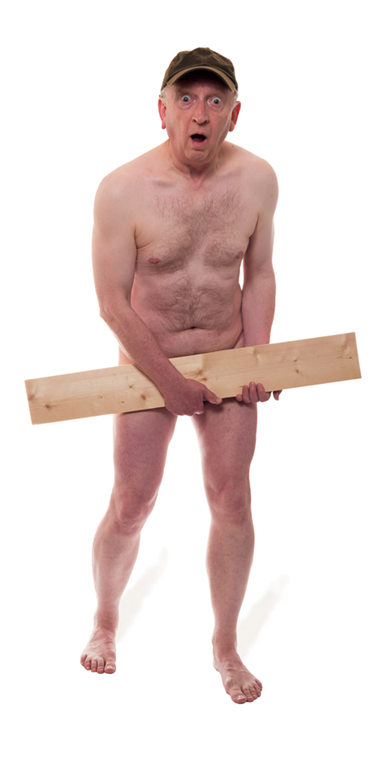
Dick Stanley – actor

Dick, popular British comedy actor, is photographed for the Radio Times, which is celebrating his 40 years as a ‘star’. He made his name in British-made films, specifically in 1970’s sex-comedies, the first of which was ‘He Was Only a Joiner But …’, re-enacted for this portrait. It was the first of a series (compare ‘Confessions of a …’!). The style of the image appropriates a popular magazine format, with plain background and a hint of (false) shadow at the feet.  Not the easiest of self portraits to make (!), this one seeks to use the very artificial, set-up aesthetic of an obviously studio-based image, obviously manufactured pose, and slightly ‘over-the-top’ expression to portray a character who is not reticent about being photographed, even in a state of undress.  (One of the toughest tasks was learning to appear at least a little relaxed whilst operating the remote shutter release concealed behind the plank! No jokes, please!)


image

Farmer Stan

This also appropriates another popular magazine-style, using fill-flash to create sharp distinction between foreground and background lighting that produces a slightly surreal, almost studio-like look to the image. It also, frequently results in a slightly startled look in the subject. So here we have Stan apparently caught in the act of going about his business and seeming a little unsure about whether he really wants to have his photograph taken for this magazine – an ordinary guy who has spent the last fifty years working in agriculture has his moment of ‘fame’.  This is the same image that I used as an illustrative example for Assignment One.  I feel that it works well and stands up with the others that have either been re-shot or produced with intent for final submission.  I could, perhaps, re-shoot something similar on location in the village where I grew up, but at this stage, I’m not sure how much it would actually add.
 

image

Old Stan

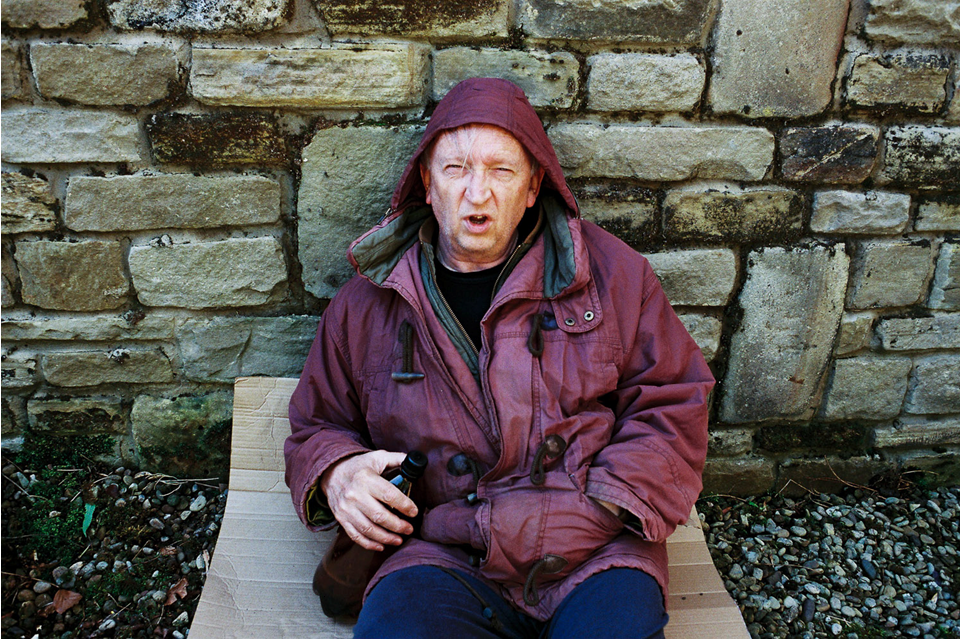
Things weren’t going too badly for Stan until he lost his engineering job in the mid-eighties. But he found it hard to deal with redundancy and, increasingly, sought solace in the bottle. He still has family and friends around who try to keep an eye on him – but he sometimes goes off for days and can regularly be found in a corner of the local church grounds. A second year photography student (Stan’s niece) shot this for her Social Documentary course, using an old 35mm film camera to try and capture something of the feel of Richard Billingham’s ‘Rays a Laugh’ series about his parents.

I actually shot a series of ‘Old Stan’ images with the D80 first, using a 24-85mm zoom lens at 29mm & ISO 400 to match up with the 28mm lens and ASA 400 film that I was planning to use on an old Praktica 35mm film camera that I bought in a charity shop some years ago. Selecting what I judged to be the best version, to achieve a kind of hopeless, semi-engaged but largely out-of-it look, I posted this one in the OCA Flickr group, looking for any reaction. (I wasn’t going to have the film versions for a few days.)

image

The response was largely positive, but there was a suggestion that the look was a bit ‘clean’ for a homeless guy. I wasn’t actually looking for ‘homeless’, so that didn’t trouble me too much, though there was a suggestion that the presence of cardboard might signify ‘homeless’ – which does make sense and might, ultimately, cause me to re-shoot this one. However, as well as perhaps being a little over-exposed, this is very much a ‘digital slr’ photograph – sharp, low on noise, etc – and whilst the look of the subject matches purpose, there could be a sense in which the aesthetic doesn’t.

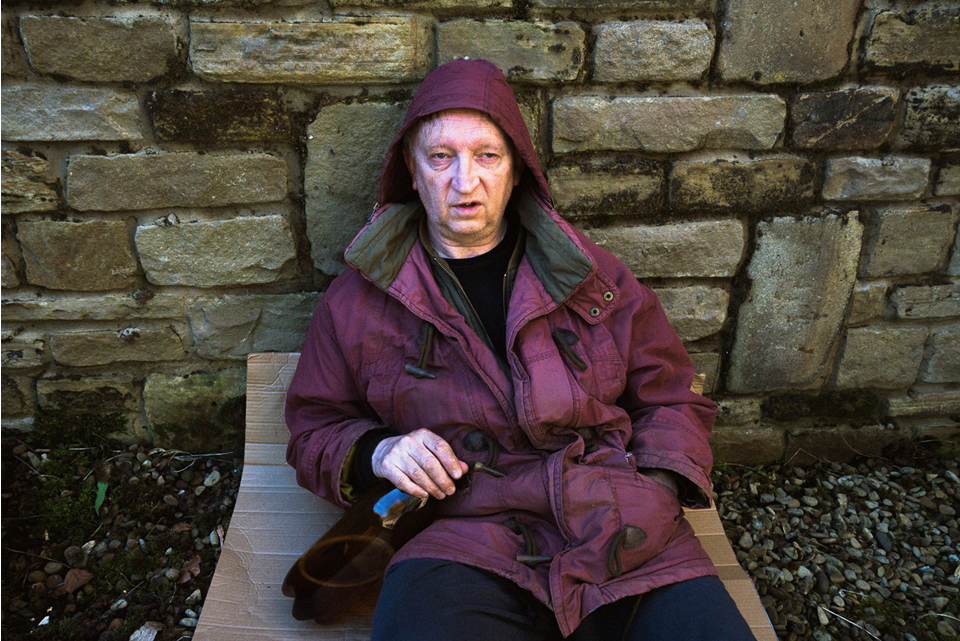
When the scanned film versions arrived, I was immediately ‘seduced’ by their grainy, dirty aesthetic – and I also liked the extra touch of aggression and engagement in the one above. Posting that on Flickr, I again got a largely positive response – but engagement with one fellow student led me to question whether those qualities could actually be re-produced in the digital version. That, with some encouragement from John, the colleague concerned, who had had a go at re-processing my original Flickr upload, led me to produce this version.
image

Correcting the over-exposure, increasing the contrast, and adding grain through a Photoshop filter, begins to get closer to the film aesthetic. This now leads to a question as to whether my preference for the film version stems from a perceived authenticity of ‘process’ – or shall we say a matching of process to subject and context. And there is also, of course, my awareness of the ‘back story’ and my invented context of the student project. There is something to unravel here. I haven’t felt it necessary to match process to appropriated style in the Bailey or Bishop images, for example, so am I just doing so in this case ‘because I can’ i.e. because I can, with little effort, lay my hands on an old 35mm film camera whereas hiring a medium format digital set-up to reproduce the Kander/Bishop image would be a very different situation. I don’t have answer, and it may not be crucial to the project, but it is something to consider as I move forward.

Another factor that will need to be resolved is the relationship between these images and any supporting ‘text’. Is it my intention that the portraits should ‘stand alone’, titled ‘Portrait 1’, ‘Portrait 2’ etc? Or do I title them ‘Bailey’s Old Mate’, ‘Bishop Stanley Dickinson’ etc ? In which case, some, such as ‘Bailey’s Old Mate’, will begin to indicate what is my intention. And, possibly, should I go the whole hog and support each with the ‘back story’ in a short paragraph? Barthes’ ‘Rhetoric of the Image’ essay gives me some theoretical background to the dilemma – but I don’t intend to resolve it just now, merely flag the fact that a decision will be necessary at some stage. It has actually occurred to me that, in some form, this issue might turn out to be an active part of the eventual presentation of the images – something that encourages a viewer to consider the visual/linguistic aspects of identity in popular 21st century culture.

So, I have five portraits to submit as part of my second assignment and I think the project is off to a good start.  I have other ideas in mind already and would hope to have a similar number ready by the time I get to a third assignment – and can incorporate any suggestions emerging from the feedback on this assignment.  I don’t have set ideas about the eventual outcome – in terms of either numbers or form of presentation, but I feel I am likely to be looking in the region of 20+ portraits, if the project is to have credibility.  Might be ambitious, but that’s what I have in mind at this stage.

Two sculptors–compare and contrast!

I have seen solo exhibitions of the work of two women sculptors in the last two weeks – and it is hard to imagine two more contrasting bodies of work!  Both inspirational; both fascinating to explore; both highly talented and renowned artists in their own right; and not without their points of similarity; but what different outcomes!

Ursula Von Rydingsvard, born in 1942 Germany, with a Polish mother and Ukrainian father, was mostly in refugee camps until the family emigrated to the USA, where Ursula has subsequently spent most of her life.  She has her first major European exhibition at the Yorkshire Sculpture Park – see here.  Joana Vasconcelos is a generation younger, born in 1971 in Portugal.  Her work is on show at the Manchester Art Gallery – see here.  The exhibition publicity describes Vasconcelos’ work as “… exquisitely crafted, monumental sculptures and installations …”; you could use the same words for Von Rydingsvard’s work, too.  Hers is also described as “… ranging from the intimate to the immense in scale …”, which could also be said of Vasconcelos’.  Other similarities can be found, with Vasconcelos “… inspired by the products and materials of Portuguese daily life …” and Von Rydingsvard producing “… sculptural forms, which at times reference … simple, rustic items such as shovels, spoons and bowls …” … “… her Polish heritage is vitally important …”.

However, whether it is the generational difference, the contrast between Northern and Southern European genes, or just two very different personalities, their creative outcomes are in sharp contrast.  Here, with apologies for the quality of the image, is a typical piece from Von Rydingsvard.

IMG_0227

She mostly works with cedar, constructing her forms from 2×4 or 4×4 beams, which are carefully, marked, cut, and assembled together – hundreds of individual pieces forming this type of abstract shape.  Using graphite to subsequently darken parts of the surface, she works with a very limited colour palate, and even said, in a short film, that she does not feel comfortable with colour, sensing that it overwhelms everything else.  (Where have I heard that type of comment before?!)  The surfaces are hard-edged and rough-cut, despite the apparently smooth form, and are marked with thick pencil lines, where she has matched edges and drawn lines where her ‘cutters’ (skilled guys using circular saws to her precise instructions) are to work.  The process is intense and serious – words that could also be used to describe the personality she portrays in interviews.  She refers to growing up in an environment where you were expected to work and work, where you smiled only occasionally and laughed only when appropriate.

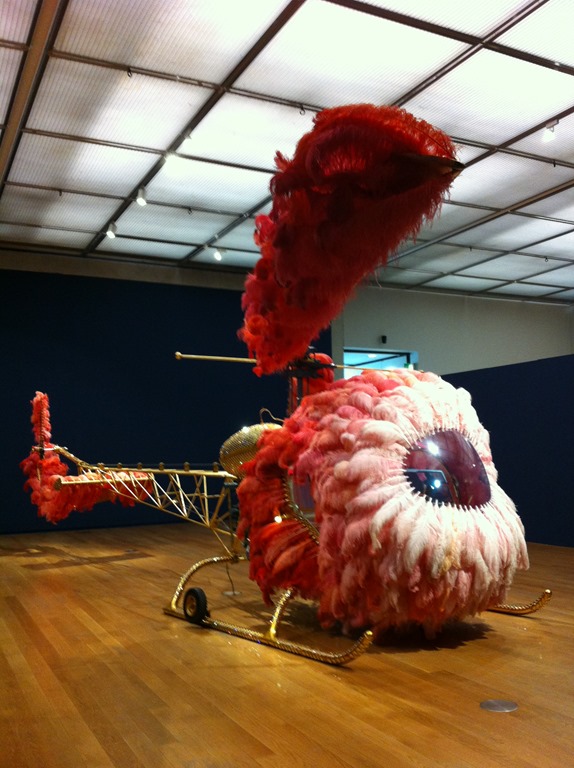
This is one of the central pieces of the Vasconcelos exhibition.

IMG_0208

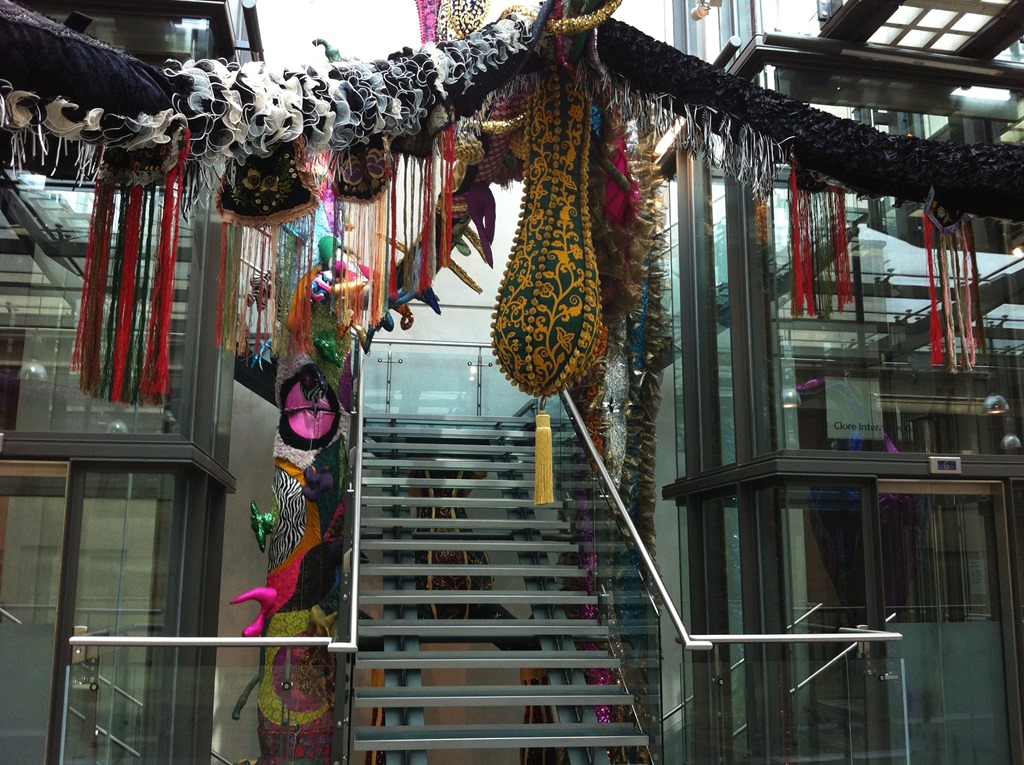
It is a (real) Bell 47 helicopter that has been covered with pink ostrich feathers, gold leaf, and Szarovski crystals; and has had an interior makeover involving intricate woodwork, embroidered upholstery, gilding and Arraiolos rugs.  It is the artist’s vision of what Marie Antoinette would be travelling in if she were alive today!  There was a 1950s Morris Oxford, full of cuddly toys and covered with toy guns, called ‘War Games’, and a piece called ‘Full Steam Ahead (Red, Green and Yellow)’, made from dozens of domestic steam irons.  Humorous, subversive, and with a light-hearted touch, her work is a “… critique of contemporary society, destabilising traditional views of female sexuality, the status of women and consumer culture …” (the exhibition brochure says).  As well as this type of appropriation of ready-mades, she also creates huge works, intricately constructed from textiles, embroidery, crochet work, etc, decorated with tassels and crystals, in vibrant colours – such as this partial view of an enormous special installation in the Manchester Art Gallery Atrium.

IMG_0219

These contrasting works are, of course, characteristic of the modernist/postmodernist comparison; with Von Rydingsvard firmly in the modernist ‘camp’ and Vasconcelos in the postmodernist.  The former creates intensely personal work, exploring process, form and material, that is deliberately ambiguous, “… with a feeling of intense humanity and sincerity …”.  The latter has fun, and playfully responds to the global society in which she has grown-up – provoking questions and subverting, certainly, but wilfully attracting our attention and seducing our eyes as well.

I should say that I thoroughly enjoyed looking at both women’s work.  I am endlessly fascinated to watch the creative processes of artists – and the films of Von Rydingsvard studio were particularly interesting in that respect.  She speaks very honestly and openly about her approach.  As a student of Photography, I do find sculpture particularly interesting.  I’m not saying I always understand it, fully, but the physicality and three-dimensionality have something extra to offer, and I think my own interest in collage and assemblage is informed and inspired by sculptural work.  I looked at the way Von Rydingsvard layers and builds up her forms and wondered whether there is something else there to try out with my ‘cut-outs’ – layering them to give extra sense of dimension and physicality.  Not sure whether I can recall seeing anyone else do that – but I’m certain someone must have!

The Hanging at Bailey’s Stardust

_DSF1471

In the context of my ‘Self-Portraits’, it was useful to visit the David Bailey ‘Stardust’ exhibition at the National Portrait Gallery on Sunday.  Bailey isn’t a photographer who comes in for much close examination in the realms of academia (so far as I know) but he is a significant creator of images in popular visual culture in the second half of the 20th century – and I have chosen to use his ‘style’ for one of my first self-portraits.  There were no great surprises in this extensive presentation of his work; I had seen a TV preview with Bailey himself (who also curated the exhibition), so pretty much knew what to expect.  It is, though, interesting to see the ‘documentary’ work that he has done in, for example, India and Papua New Guinea, alongside the celebrity and fashion images, for which he is best known.

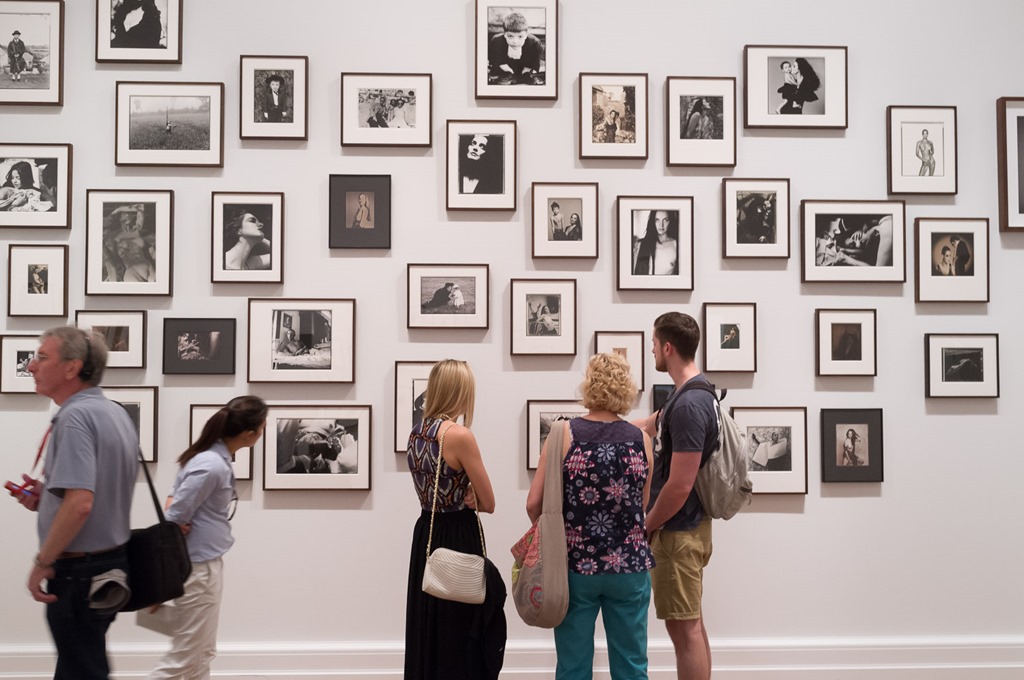
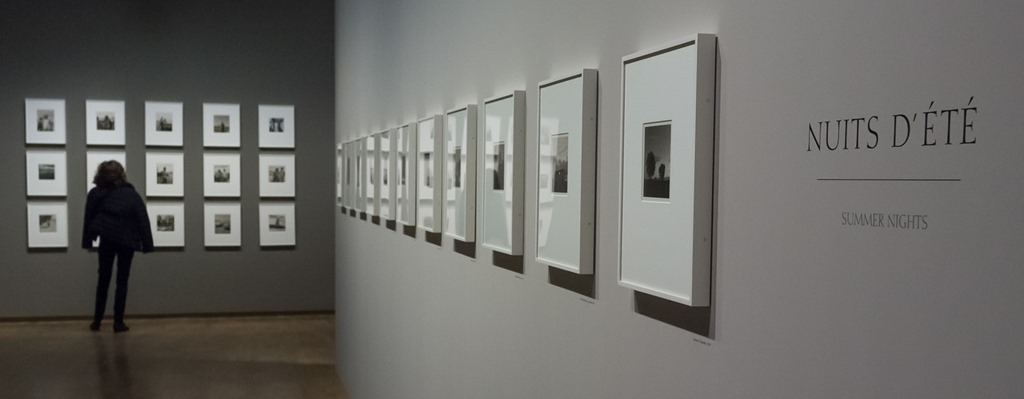
The aspect on which I feel most keen to comment is the ‘hanging’ and, in particular, what I can only describe as ‘display walls’.  It is the tendency to hang images high on the wall, which I also noted at some the Paris exhibitions last month, that fascinates me.  This ‘family wall’, chiefly featuring photographs of his wife, Catherine, is the best example.

_DSF1473

THESE IMAGES ARE NOT MEANT TO BE LOOKED AT!

It is physically impossible for anyone to look at most of the photographs on this wall and so the only conclusion is that he does not want us to look at them closely. (I might say, in passing, that the larger prints in some of the other rooms were also well above natural eye-level, for an averagely tall person.)  One can only step back, as I did in taking this photograph, and stare at the ‘spectacle of the display’.  I am tempted to compare this approach to the barrage of visual images we see every day online and in publications – individual images are ‘devalued’ by the impact of quantity, so that it becomes impossible to actually ‘read’ anything from them.  In this case, I would suggest that they neither say anything individually nor as a series.  It’s more like something done by an interior designer than an an exhibition of photographs.

In the Sky Arts interview referred to previously, Bailey pays tribute to Catherine, his wife and muse, so, speculating about Bailey’s purpose in presenting them like this, I tend towards the idea that he sees the ‘spectacle’ as a kind of physical and visual tribute, an expression of pride in his family perhaps.  The room is specifically titled ‘Catherine Bailey’.  However, it is not a style unique to this show.  There was evidence of the same approach in both the Cartier-Bresson and Mapplethorpe exhibitions in Paris.  And whilst that might lead one to think of it as a modernist trope, glorifying the images display, I then recall that it also happened in the more contemporary context of the Ponte City exhibition at Le Bal.  As I say, ‘spectacle’ is the word that keeps coming to mind – impressing with the overall impact rather than homing into either individual images or, say, the narrative of a series.

So, it was particularly interesting to compare the same approach again, next day, at Tate Modern, but in a rather different context.

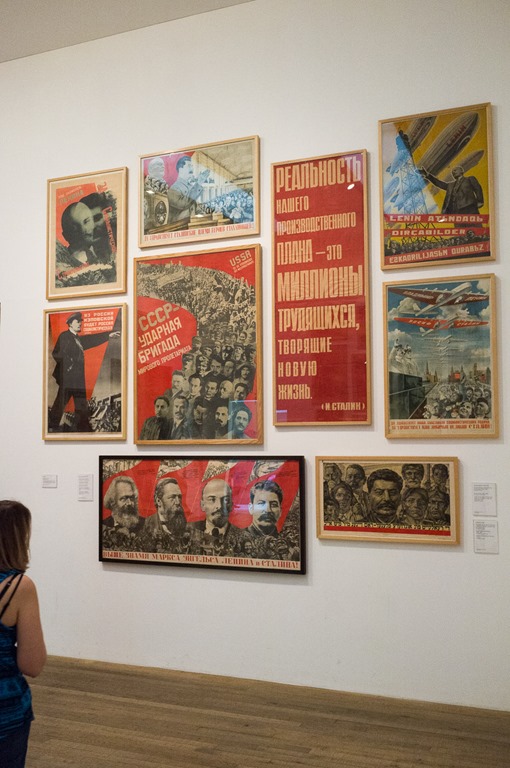
_DSF1485_DSF1486_DSF1487

These are street posters from the Russian Revolution.  They are specifically about display and propaganda, of course; about creating an impression rather than passing on information or illustrating something specific.  They are also intended to be viewed from afar.  So the overall impression of style and colour comes together well in these big, multiple displays, which cover three walls of a single room.  I am, I have to say, rather less convinced by the effectiveness of the ‘wall-filling’ approach when used for 40-or-so smallish black & white framed prints on a high wall at the NPG.

Semiotics and the ‘Textbook’ Project


Stability-of-the-latent-image.jpg

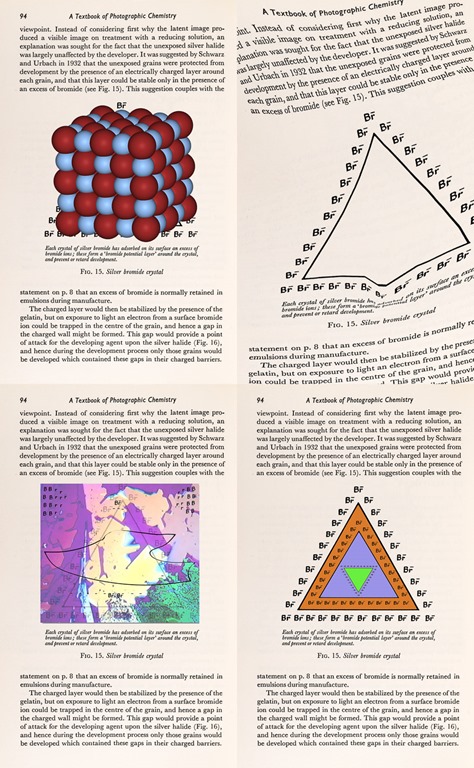
I attended an OCA Lecture day in Leeds at the weekend – delivered by OCA Art History & Visual Studies Tutor, Gerald Deslandes. Reflections on the day, which was devoted to the origins and development of Modernism & Postmodernism, are better suited to Contextual Studies but, as I said to Gerald as I was leaving, much of what he covered helped me to feel more confident about some of the work I’m doing in Body of Work.  I’m not sure that it was the lectures, specifically, that made me think afresh about my ‘Textbook’ project this morning, only partially I suspect, but something has led me to what feels like a better understanding of what this project is about.

In my previous post about it – here – I put it in the context of Analogue and Digital photographic processes, and that is certainly valid, but I realised this morning that it is also – more so, maybe – about Language and Signs.  The words, diagrams and images from this 1963 publication have lost, for me, their original meaning.  They do not signify what the writers intended.  For me, they signify an unintelligible, dead, language.  But, rather than approaching them like an archaeologist, seeking to decipher their original meaning, I appropriate them as unattached signifiers.  I construct something new, something whose ‘meaning’, for me, is the investigation and expression of my own creative use of digital methods, and which is an expression of the ‘ambiguity’ I discussed here.

The image above is a good example – and includes a ‘text’ based element, too.  Reading the image, as it is presented here, one might start with a formal analysis.  It is, clearly and obviously, a construction.  There is a ‘cut-out’ image in the foreground and some other ‘cut-outs’ in the background, with a slight background difference between the top third of the frame and the lower two-thirds, which together seem to suggest that this is a representation of a ‘landscape’.  the colour of the background (and the image of a polar bear in the foreground) appear to be specifically representing a ‘polar’ landscape, further confirmed by the suggestion of what appears to be snow around the boots of the two men in that foreground ‘cut-out’ image.  This foreground image seems to have been cut from an old photograph, its surface suggests the graininess of such an origin, and the dress of the two men also seems to signify the early part of the 20th century.  Each man is holding a rifle at his side, resting the butt on the floor and grasping the barrel.  They stand, slightly apart from each other, looking down at what must be a dead polar bear – and we almost certainly reach the conclusion that they shot it.  Two men, in the early part of the 20th century, shot a polar bear in a polar landscape!  They were photographed with the carcass, and I have now chosen, in the early part of the 21st century, to cut out their images from an old print of some nature!

Then we come to the other cut-outs, in the background.  There are four triangular shapes, each with a kind of bulge on the side. Three, positioned right at the back of the ‘landscape’ and to the left, are coloured light blue, with their ‘bulges’ in purple; the fourth, a little closer and larger, is coloured purple, with a black bulge.  They look as though they have been cut out from a printed source; each has a thin black outline and there are black spots printed inside each triangle.  Some also have other printed symbols – plusses and minuses, and arrows, in one case.  They have a diagrammatic look about them, though there is nothing to suggest what they might represent.  One of the blue triangles also has symbols outside its cut out shape – arrows pointing down to its left hand side and minus signs around its purple bulge.  All four of the triangles are slightly out of focus – though the arrows and minuses just identified are quite sharply defined.  Although the colours and diagrammatic qualities of these four triangles does not support such a conclusion, one might suppose that they have been placed to loosely suggest mountains in the polar landscape.  The ‘trained’ eye might read these diagrams as having some scientific significance, but there is little or nothing to explain what that might be.

Finally, within the frame of the image, there is a printed ‘caption’, which reads ‘Fig. 24. Stability of the latent image’.  The ‘content’ and the style of presentation of this text would seem to suggest that the image is either from, or we’re asked to consider that it might be from, a book, maybe an academically oriented book, given the use of ‘Fig. 24.’ and the specific nature of the language of the text.  All these symbolic elements – the foreground cut-out; the four triangle cut-outs; the ‘landscape’ background; and the caption – have been deliberately brought together for some purpose.  The ‘formal’ analysis of the image doesn’t necessarily lead to a clear conclusion and probably raises as many questions as it answers.  Contextually, presented as ‘art’, the image would probably be identified as having characteristics of the postmodern, and so the questions are about the artist and his purpose.  In any other context, the image is likely to be seen as curious and/or meaningless.  Printed large on a gallery wall, it would invite a close examination of its aesthetic qualities, which would (hopefully) lend it some ‘art-context’ credibility – the signification associated with a large, high-quality print and curatorial support.  As one of a series of images in a gallery (with supporting ‘artist statement’ and curatorial text) or, similarly, in a book of images, all based around some linking theme (perhaps all images made from the ‘Textbook’ for example) and with supporting text, it may begin to have some ‘significance’ in the analogue/digital context.

Fundamentally, though, it is a somewhat ambiguous collection of signifiers that are unlikely, without further information or context, to communicate much beyond the fact that I, the artist, chose to put them together and create this image.  Those who look at it – tutor and fellow students, for example – may be sufficiently drawn to begin speculating about my purpose/process and the origins of the individual parts of the image – but they will probably have to construct their own conclusions because there is little in the image itself to help.  Hence my own conclusion that I am appropriating these unattached signifiers and presenting them in a construction that has no significance beyond its own construct!  Interestingly, though, because I do know exactly where these individual elements of the image came from, I also know that they are not quite so unconnected as they may seem.  The triangular diagrams (which were not coloured in their original form) represent crystals of silver bromide, each with a speck of silver sulphide attached, and the sequence represents the process of formation of a ‘latent image’.  The foreground image was taken on a fatal polar expedition in 1897 but the exposed film lay in the icy environment for 33 years before being discovered and developed; that’s why it was included in a section of the book entitled ‘The Stability of the Latent Image’.  There, I’ve spoiled it now!

Through ambiguity to seeing more clearly

An Image Without Meaning

Image without meaning

I have reflected positively before in here about the ‘thinking with’ approach that appears in the module notes.  The notes also encourage the use of a notebook in which to write regular thoughts and get rid of the “boring stream of consciousness” (which I have always done anyway).  It also says “Please don’t put all the boring stuff on your blogs!”.  Spoken from the heart of a tutor/assessor, I think.

A few weeks ago, I had one of those ‘stream of consciousness’ sessions; it came out of a ‘what the hell am I doing?’ moment; and I did grab a piece of paper and write on it – before stuffing it into the notebook and forgetting about it.  Today, coincidentally, I took it out and re-read it a few moments after I had been re-reading Chapter 8 of ‘Visual Culture’’’ by Howells and Negreiros, for Contextual Studies.  It’s a chapter on Photography and, amongst other things, it looks at the relationship between photography &reality and runs through the arguments around photography as art.

So, here, in summary, is what was in my notebook reflections from a few weeks ago:

What am I doing?

I am constructing images (maybe not photographs?).

My images may …

  • attract attention;
  • invite further investigation;
  • provoke questions;
  • encourage thought and speculation;
  • seem to promise meaning and truth;
  • entertain;
  • please;
  • frustrate.

But, like all images (maybe) …

  • lack substance;
  • hold no answers;
  • provide no solutions;
  • be ‘unreal’;
  • fail to satisfy.

Ambiguity – I am creating ambiguity.

There was more, but I’ll adhere to the module author’s request!

As I said, the Howells & Negreiros chapter looks at the photograph’s relationship with reality.  Personally, I long since abandoned any notion that photography presents truth and/or reality; and I recognise the need to question the meaning and relevance of those two concepts – certainly to recognise that they are open to interpretation.  However, the chapter does acknowledge that but argues, even accepting what I’ve just suggested, that photography does have a “special relationship” with reality.  They suggest that the photograph manages to be an “… hallucination which is also a fact …”.  That idea certainly is important and relevant – the potential for a photograph to be read as real, or as a representation of the real, or to seem/feel real when it isn’t; the possibility of knowing that it isn’t what it seems to be yet being drawn to look and read and take something from the process – even just speculation about intent or process.

So, I combine a dip into my own stream of consciousness with a spot of contextual reading and seem to feel that something significant has been distilled out of the process.  I was right – I am creating ambiguity.

Textbook–starting out on another studio project

Textbook 01

I’ve had a bit of a bee in my bonnet about the apparent prominence of ‘film-based’ analogue capture of images by photographic artists – including several of those mentioned in my earlier post here.  I ‘stirred the pot’ some weeks ago, in the OCA Flickr Group, resulting in this discussion; and there have been others in that forum, including this one.  Of course, artists will work within the medium which, in terms of process and outcome, delivers work that satisfies their creative objectives – I have no concern about that, why should I.  Naturally, many of the artists whose work populates the gallery walls began their practice before digital capture was either available or affordable, and that work is already created, so would represent the pre-digital approach (though there does seem to be a strong trend toward digital print methods).  That ‘bee buzz’ has more to do with the question of why there doesn’t seem, as far as I can tell, to be some stronger indication that young, up-and-coming photographic artists are working extensively with digital capture and exploring the creative possibilities that digital methods can offer.  It’s an open question; but also one that concerns me personally, in that I work wholly with digital methods and have no intention of doing otherwise.  I do also sense a wider struggle to come to terms (understandably) with what the digital/internet age ‘means’ for ‘photography’.  I might just be missing it, but is there extensive critical discussion of the question?

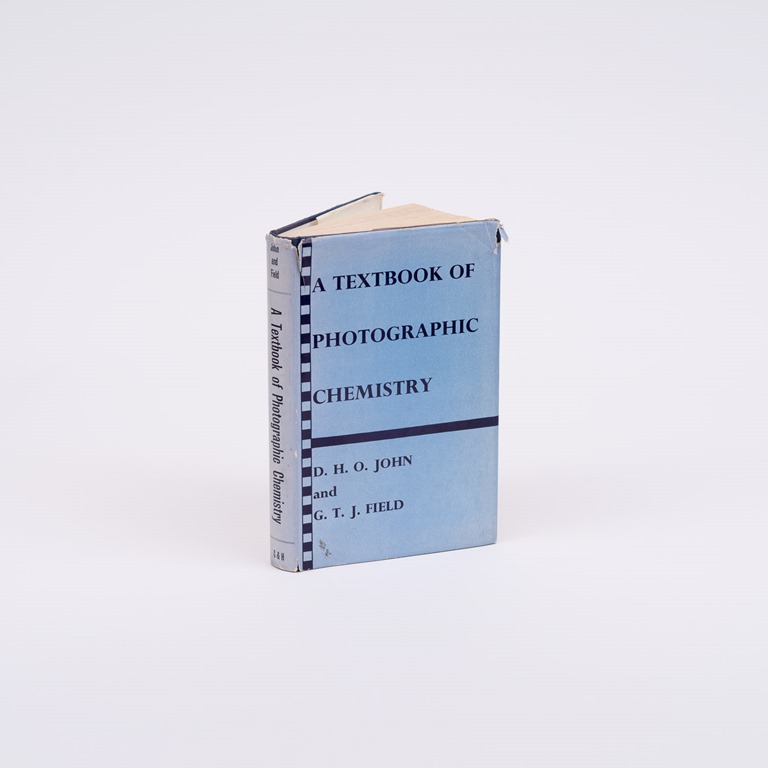
So – here is a topic that interests me – and, whilst browsing a local second-hand bookshop, I came upon this publication from 1963, which might just act as a medium for some photographic ‘thinking-with’.  Much of this book reads like a foreign language, to me. (Brief pause, here, to confess that I have failed two exams in my life, one of which was Chemistry – and the other was an equally foreign language, Latin.)  Consequently, I find myself looking at it, and through it, rather like a historical artefact – something from another age.  It occurred to me that I might approach it as a subject for a studio project, seeing it as a kind of metaphor for the whole of film/analogue/traditional photographic practice.  It might be a ‘taking apart’, a ‘deconstructing’, maybe a ‘subverting’, or even a ‘glorifying’ – I even had the idea that I might, eventually, literally take it apart bit-by-bit and photograph the process.  And, without jumping too far ahead, I could envisage an ultimate outcome in book form, perhaps as a part of my final Body of Work.  So, I have begun the process and here is a selection from the images produced so far.


Textbook 03

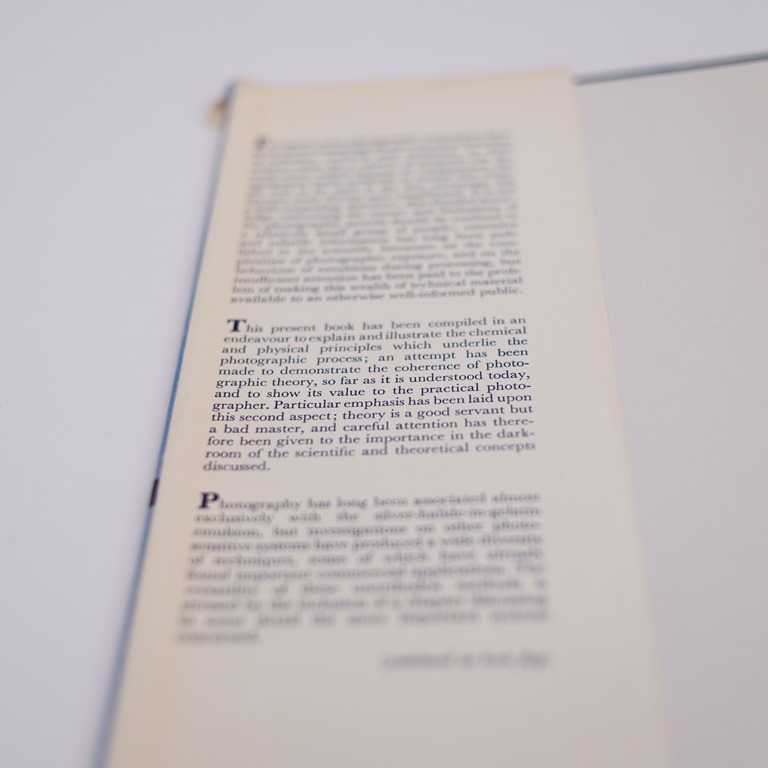
I found the references to “photographic theory” on the book jacket interesting – the use of the word ‘coherence’ and the reference to theory as “… a good servant but a bad master …”.  We, students of Photography in 2014, are likely to read that rather differently than it would have been read 50 years ago.


Textbook 05Textbook 04

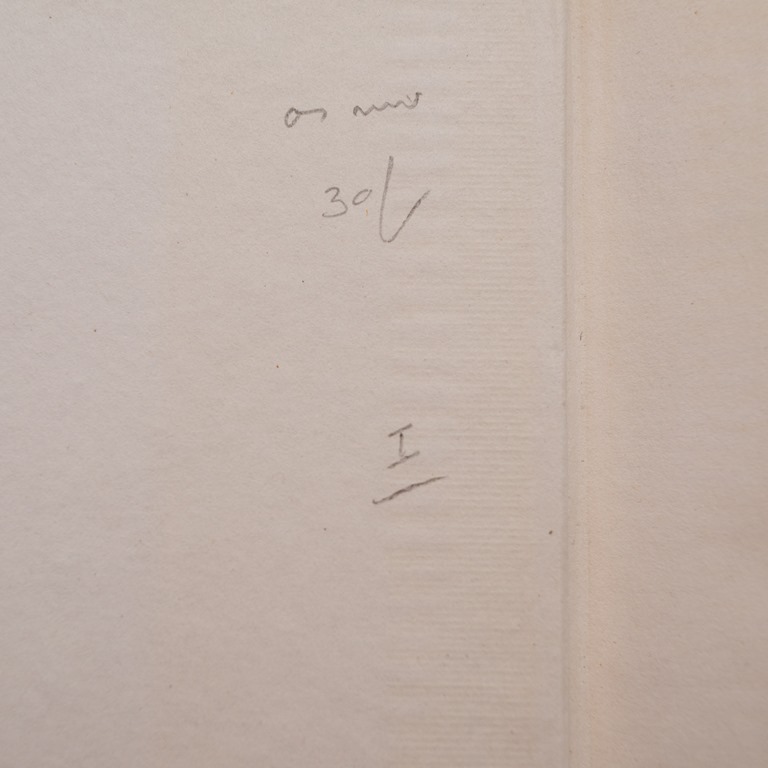
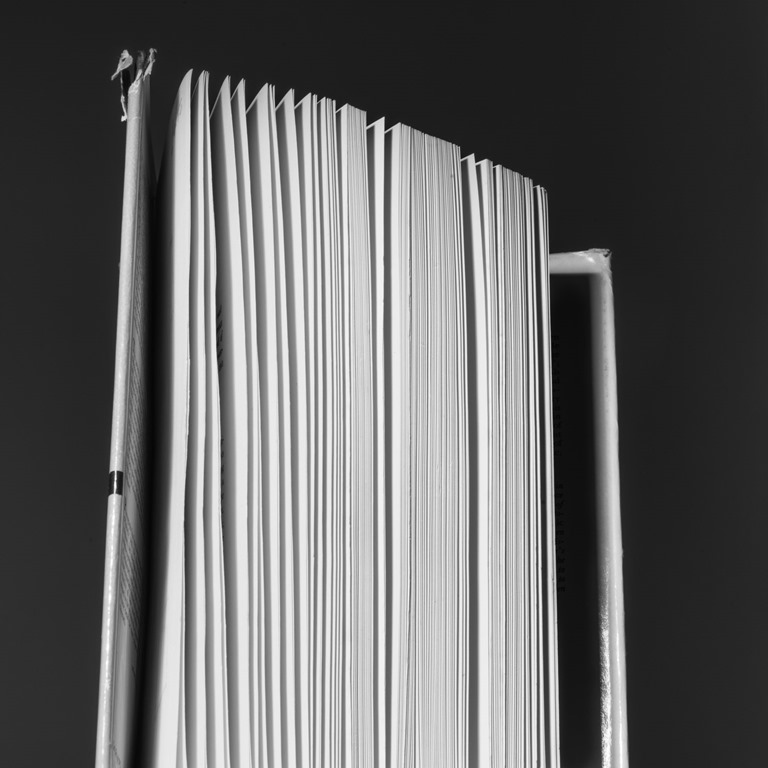
The physical characteristics of the book itself, photographed in a kind of forensic manner, reveal signs of age, mysteriously-shaped stains that suggest chemical reactions over time – rather like the chemically-based process that is its subject; odd scribbles that must have meant something to someone in the past – shades of the photographic archive.


Textbook 07

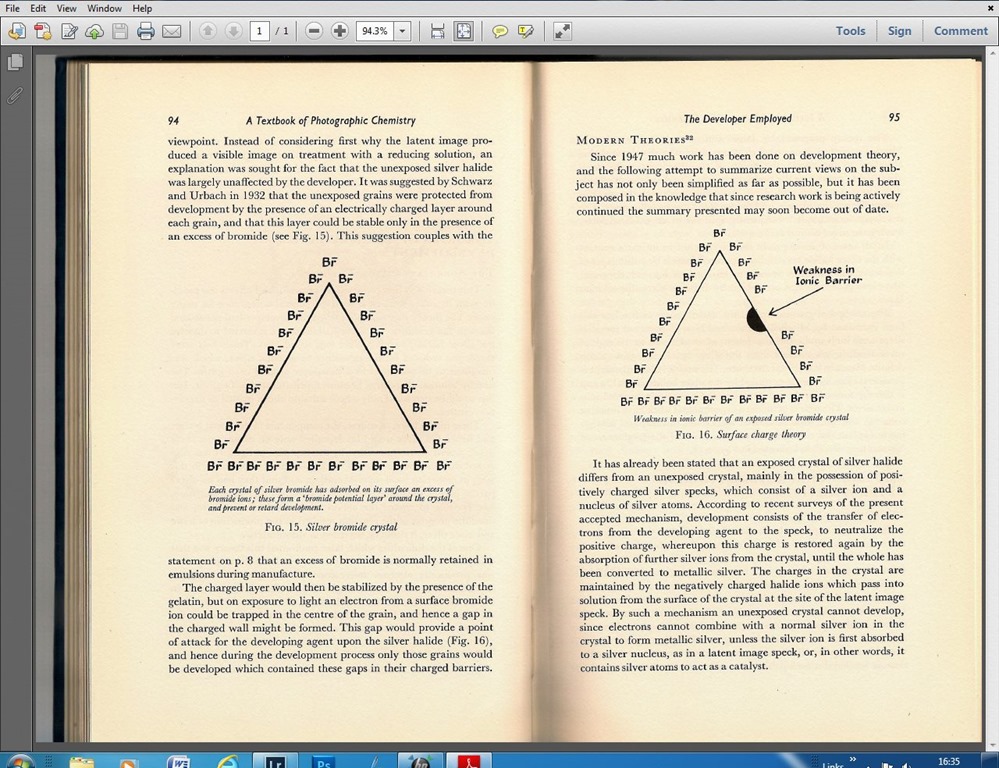
The process doesn’t have to be restricted to ‘taking photographs’; this page spread has been scanned into a PDF, which has been opened on the PC and a ‘screen-shot’ taken – thinking about the ways in which the scope of current technology compares with that of 50 years ago.


Textbook 12

But then taking that whole process even further, manipulating and re-presenting material; adding elements that both emphasise the ‘gulf’ between these approaches and ‘enhance’ the visual impression, but also applying the deliberately clumsy ‘Photoshop’ methods that I’ve used before.


Textbook 11

And/or going in a different direction by using a deliberately ‘modernist’ aesthetic to present the subject; believe it or not, I had in mind Ansel Adams & the Yosemite National Park when I made this one.

This work, plus the images of ‘Tapes’, and some work I’m doing on the Self-portraits, is beginning to move me towards a second assignment submission in the next few weeks – hopefully.

Paris in the Springtime–Episode Three

Les Invalides (1 of 1)

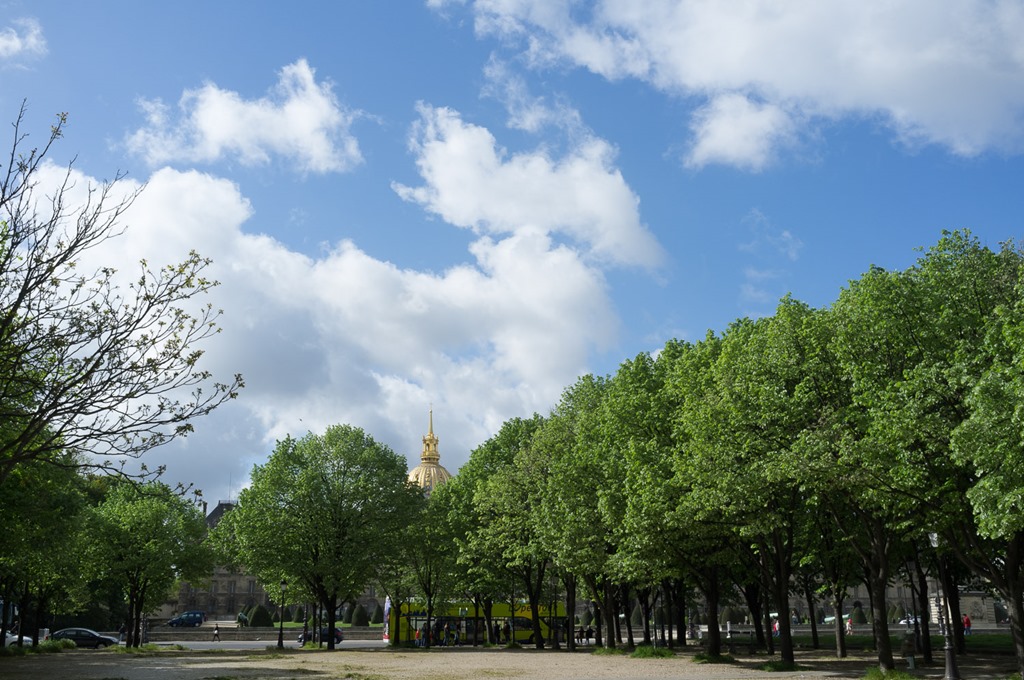
Les Invalides lies just over the Pont Alexandre III from the Grand Palais, where a major exhibition of the work of Robert Mapplethorpe was on show, and very close to Rue Varenne, location of the Rodin Museum, where there was a corresponding exhibition comparing the works of Mapplethorpe and Rodin.  I was able to see both last week – another experience that left me with a sense of privilege.

Mapplethorpe’s work isn’t always easy to deal with, of course.  There has never been any problem with his images of flowers and his studies of the human body are highly respected – hence the Rodin comparison – but when he moves into the erotic and exotic, it may not always be comfortable viewing.  Though, actually, these exhibitions have largely changed my view on that point.  In this video on the Grand Palais website, his long-time friend and collaborator, Patti Smith, says that he sought to raise the sexual and erotic to the status of ‘art’ – putting flowers, the body, genitalia on an even footing.  Avoiding for now any debates about what might comprise ‘art, this exhibition demonstrates that he succeeded.  A hugely-printed quote, early in the Grand Palais show, has Mapplethorpe adoring and in awe of the human body; another has him seeking perfection in form.  The latter is clear from the exceptional quality of the prints on show in both exhibitions.  It is through the strenuous application and maintenance these very, very high aesthetic standards that he enables us to look at, and even respect, subject matter that we might otherwise struggle with.  It confirms, for all of us, the importance of setting such high standards and striving always for the very best in presentational quality.  (Something that fellow student, Amano, and I observed to be rather less in evidence at another exhibition we visited, described by him here.)

In the Mapplethorpe-Rodin comparison, I found myself making some value judgements about the sculptor versus the photographer – a meaningless exercise in the end, but an interesting opportunity to make such comparison across media.  The basic reaction, I think, is to sense that creating a meaningful, three-dimensional form that speaks very clearly about the human body, forming it ‘hands-on’ from some basic material and an empty piece of space, that is probably a greater challenge than using the medium of a ‘machine’ to create a two-dimensional photographic image.  But then, to create a sense of ‘real’ three-dimensional form on a flat surface, with a true impression of form and texture, that too is a challenge, whatever the medium.  It doesn’t greatly matter, as I say, but looking at the two, side-by-side inevitably leads to those thoughts.  The curators used a number of areas of comparison in order to give the exhibition structure – black & white; highlighting of detail; texture; use of drapery; assemblage; erotic/sexual content being some of the key ones.  The notes in the leaflet accompanying the Grand Palais exhibition describes Mapplethorpe as “A sculptor at heart …” and an “Admirer of Michaelangelo …” who “… championed the classical ideal …”.  So much is clear from these shows; and one feels that he would have been delighted to see his work on display in these grand surroundings and directly compared to Rodin.

One aspect that was of particular interest to me, in the context of my Body of Work was Mapplethorpe’s Self Portraits.  There were several, scattered around both exhibitions, as they are ‘scattered’ through his lifetime.  I enjoyed the sense of ‘performance’ in them – certainly exploring different sides of his character, but with a sense of wit and performance nonetheless – even the 1988 one that featured in the Grand Palais publicity and posters, taken when he knew that death was unlikely to be far away.  And there was a direct parallel in one of the exhibitions running alongside the Martin Parr at the Maison Européenne de la Photographie – Luciano Castelli.  More colourful and flamboyant than the Mapplethorpe’s, perhaps, but very much of the same era.  Which provides an opportunity to mention another Mapplethorpe quote from the Grand Palais, that he “… looked to photograph the world and its curiosities … what was New York at that time … it couldn’t have been done anywhere else …”.

The Pompidou Centre was featuring a major exhibition of another great photographer of his time – Henri Cartier-Bresson.  I had already seen a big presentation of his work at the National Media Museum, in Bradford, some years ago – Scrapbook: Photographs 1932-46 – so a lot of the work on show was familiar.  There is no doubting Cartier-Bresson’s enormous contribution to the development of Photography, as art and in documentary/photojournalistic terms, and this exhibition explored it to the fullest extent – adding painting & drawing plus later photo-journalistic work & contextual material to the images I’d seen previously.  I probably prefer the earlier, more art-based work myself, but some of the material presented in relation to his work for the communist newspaper, Ce Soir, was interesting.

Cartier Bresson - Centre Pompidou (1 of 1)

This collection (note the high hanging again!) is of features about ‘lost children’.  It all seems have been a bit of a ‘set-up’, whereby the newspaper miraculously and joyously re-unites the children with their parents.  There is nothing new in the world of journalism, clearly.  There is a famous Cartier-Bresson photograph taken in Moscow in 1954, which is featured in this Guardian article.  It was interesting to see, in the Pompidou Centre exhibition, examples of range of magazines and journals in which it subsequently featured.  So, this is an extensive presentation of Cartier-Bresson, his work, and the context – well worth the visit.

There was one element that ‘wound me up’ (not always too difficult these days, I admit).  Most Cartier-Bresson shows would, rightly, feature his photographs taken in the UK in 1937, when he was commissioned (by Ce Soir again, I think) to cover the coronation of King George VI.  He famously took many photographs of the crowd and few, if any, of the royalty.  This was the English translation of the text that accompanied some of these images in the exhibition at the Pompidou Centre:

Watching the king go by

In May 1937, Cartier-Bresson was sent to London by the Communist daily newspaper Ce Soir to photograph the coronation of George VI. The pictures he took showed not the new monarch but people looking at him. The photographer was particularly interested by the devices for aiding vision used by the spectators. Here it is important to understand that these optic devices, ranging from a simple mirror tied to the end of a stick to the most sophisticated periscopes, obliged the viewers to turn their backs on the king to see him as he went by. In the Sixties and Seventies, Michel Foucault showed how far the positioning of bodies in space and the use of optical devices led to situations of power. In 1937, Cartier-Bresson had already grasped this entirely. By photographing the people’s about turn, he envisaged the overthrow of power. This is what gives his pictures an eminently revolutionary value.

Without doing more research into what Cartier-Bresson himself might have said about the images, I can’t be sure; but does one feel that the writer is trying to make rather more of these documentary/journalistic images than they warrant by suggesting they preempted Foucault; and which particular overthrow of power is being envisaged?  As I say, I am easily wound-up these days!

Paris in the Springtime–Episode Two

Lilac in Paris April 2014 (1 of 1)

Indulgence in some ‘pretty’ photography – why not?  This is the second of three, maybe four, write-ups from my visit to Paris last week.  Here, I’m focusing on two more contemporary exhibitions – in terms of subjects, artists and presentation.

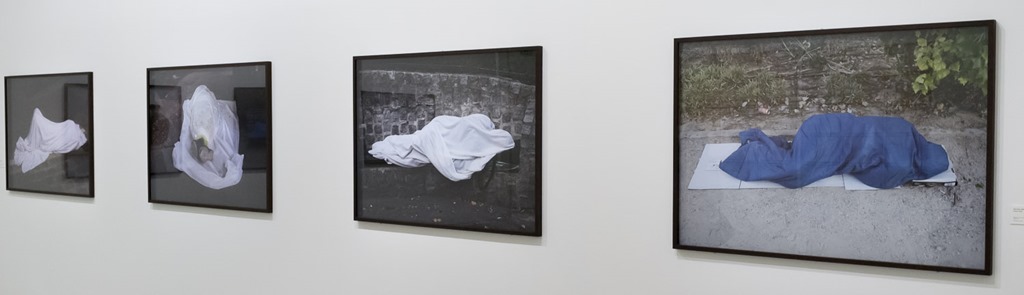
As well as the Robert Adams (blogged here), Jeu de Paume also had a sizeable exhibition of works by French photographer, Mathieu Pernot.  New to me, Pernot, the exhibition notes tell me, “… specialises in documentary work, but offers a new take on the codes of this photographic genre …”, exploring “… alternative paths …” to develop a “… multi-voiced narrative …”.  The reference to genre leads me to link his work with Part One of this module.  He uses archive, found images and elements of psychogeography, which, apart from the fact that I found the work genuinely interesting and stimulating, makes him particularly apt for this blog.  The exhibition presented works from around 10 or 11 different series that he has produced over the last twenty or so years, with a common – though not exclusive – theme of nomadic and precarious characters e.g. gypsies and migrants.  In other hands, images of such subject matter can seem separate – the ‘other’ – but I got much less of that sensation from Pernot’s work.  In some cases, I think, this was because it felt more genuinely ‘involved’ and collaborative e.g. Giovanni 1995-2012, where he has photographed the same subject, a Roma Gypsy, over an eighteen year period.  In others, oddly, it was an element of abstraction and detachment that avoided the sense of exploitation that can sometimes go with ‘other’ photography.  The series below, called Migrants, is a case in point.

Mathieu Pernot The Migrants (1 of 1)

Pernot has photographed Afghan migrants, in a Paris square where they gather, early in the morning before they are moved on by the police.  Recording them under their blankets, sleeping bags etc may, as the the exhibition notes say, reduce them “… to the condition of simple forms …” but it also seems to make it possible for me to look at them and speculate about their situation without the sense of exploitation that I can feel when the face is looking back.  I’m not sure how rational that is or whether it is something other viewers feel but I got more out of these images than the hundreds of photographs of migrants that I’ve seen in newspapers or other exhibitions of documentary work.  It might simply be that these are ‘different’ or it might be because they are more like still-life images.  Also, just the day before, I’d been at the Rodin Museum where one line of comparison between him and Robert Mapplethorpe (coming up in Episode Three) was the use of drapery.  Whilst coming nowhere near the aesthetic qualities of a Rodin sculpture or a Mapplethorpe print, there is something directly comparable about these, to which is added the dimension that these are ‘real’ (dangerous word!).  There is someone under there with a real story (one of which, by the way, was recorded on the opposite wall in The Afghan Notebooks).

Mathieu Pernot Witnesses (1 of 1)

This image is from another part of the Pernot exhibition, which brings together two of his series – The Best of All Worlds and Witnesses.  Both are based on a collection of sixty postcards, published between 1950 and 1980, showing high-rise housing estates in French suburbs, considered to be symbols of progress, at the time.  (Not unlike parts of Martin Parr’s Boring Postcards, but used in a somewhat different way).  In The Best of All Worlds, Pernot has simply reproduced and enlarged the postcards to ‘gallery-size’ prints, a process that obviously raises their profile but also emphasises the artificiality of the colours – and of the whole environment and the way it was being presented in the cards; as though the enlargement takes us through the veil.  In Witnesses, he goes a stage further, homing on on the tiny figures of people, accidentally caught up in the photograph (and the narrative, too, of course), and enlarging them even further so that they are no longer anonymous incidentals but the main subject of the image.  This process takes me right back to Arles, last summer, and the work of John Stezaker (blogged here), who created tiny exhibition images of figures cut from larger photographic prints).

I have been truly impressed by Pernot’s work and his “… multi-voiced narrative …”.  Rather in the way that I have thought about using studio-based work to respond to events, he has created ‘documentary’ work that moves beyond the (mere) taking of photographs, and is all the more powerful and effective for that.  There were other series worthy of note that I’m not covering here that do appear on the website – A Bohemian Camp, for example, which starts from an archive of images and documents from a camp for nomadic people created by the French Vichy government on 1942.  I would rate this one of the best exhibitions I have seen in a while.

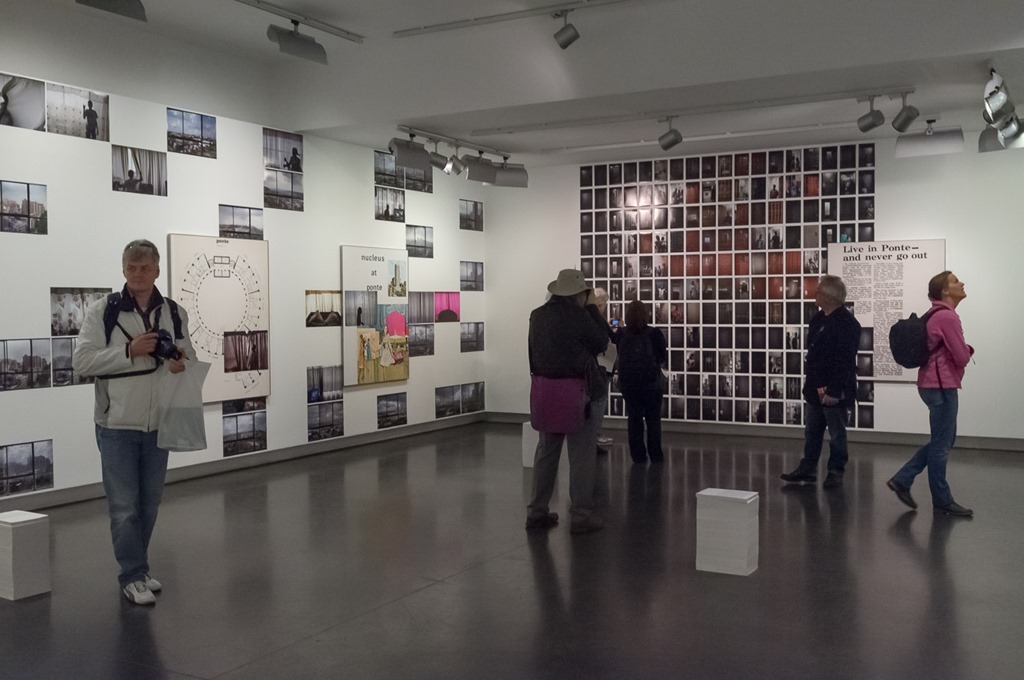
I had visit Le Bal before and this smallish gallery in Montmartre lived up to the promise of that last visit.  Quite apart from the exhibition, to which I’ll come in a moment, the space is excellent, the culture is very much contemporary photography, and the welcome & service are both excellent.  The staff at the super little cafe went out of their way to accommodate eight hungry OCA students and so ‘full marks’ for that.  This time, the exhibition was of work by two artists of whom, like Pernot, I had never heard before – Mikhael Subotzky and Patrick Waterhouse.  The former is South African and the latter British; and this was their collaboration on Ponte City.  I must admit that I had done little preparation for this particular exhibition (much of the background on Le Bal’s site being – perfectly reasonably – in French), but subsequent reading further informs me about Ponte City itself – a circular tower-block building in Johannesburg that seems to have as many stories as it has storeys (54)!  It was built during apartheid, in 1976, targeted at white middle-class couples, but has gone through various phases – sometimes seeming to epitomise the hope for a brighter South African future and sometimes seeming to represent (and house) the least positive aspects of the reality of the country’s struggles with itself, its past, and economic reality.  The exhibition seeks to explore that history – partly through new photography, some of it portrait, some documentary, some almost more typology – but also through a variety of other sources such as promotional material, architects’ drawings, found objects, old photographs, magazines, letters/communications, handwritten accounts, tear-sheets, and so on.  And it works – not especially on the level of photography itself, though that is clearly a crucial element and, to an extent, a subject of the work, but as documentary art representing social history in a varied, interesting and stimulating manner.

Subotsky & Waterhouse Le Bal (1 of 1)

This image gives a flavour of how it uses and presents the mixed media – in this case, mainly found material though there is a glimpse of a large-scale image on the right.  It also demonstrates a phenomenon that was common in this show, but also present in Pernot’s exhibition (and others on the Paris trip) – the impossibly high exhibits.  Short of taking a ladder, it is physically impossible to look at several of the images and items that are placed high on the wall.  The only conclusion is that it is meant to be viewed as a whole, as in this image, and/or that we are meant to feel a sense that however long we look we will only ever know part of the story.  Sometimes, it was intended to relate to the height of the building, as in the presentation on the far wall below.

Subotsky & Waterhouse Le Bal 2 (1 of 1)

There was no shortage of accessible material to look at, so I’m not suggesting this approach detracted from the effectiveness, but it was certainly unusual (albeit, as I say, a characteristic of more than one of the Paris shows).  As with Pernot, there is much to learn from the use of varied materials, beyond the purely photographic.  And, as fellow student Stephanie identified for us, this work has been exhibited in different ways at different locations – see here.  There was also some creative and interesting detail to reward the closer look.  Look at the combination of newly-created photograph, found image, and document in this specific exhibit.

Subotsky & Waterhouse Le Bal Detail (1 of 1)

So, two contemporary exhibitions, both operating broadly in the documentary field, which have demonstrated the effectiveness of taking a flexible and multi-faceted approach to the presentation of photographic material.  They have also introduced me to some new names to follow – especially Mathieu Pernot.

Paris in the Springtime–Episode One

Place-des-Vosges-1-of-1.jpgWhere to start?  One week in Paris; 6 galleries/museums; 9 exhibitions; oh, also, beautiful spring weather, good food, accompanied by the love of my life; and the chance to spend some good quality time with a great bunch of fellow students who had come to Paris from various corners of the world!  It was a special week.

My blogging will concentrate on the art, of course, and it looks as though it will come out in three ‘episodes’ – or maybe there will be a fourth.  There is no particular order to it, but I’m going to start with an interesting comparison between two very different photographers, who produced – unsurprisingly – two very different exhibitions.

I first spotted that there was to be a major touring exhibition of Robert Adams’ work a couple of years ago, when it opened in the USA; and also noted, at the time, that it was not coming to the UK.  So, it was a privilege to have the chance to view it at the Jeu de Paume last week.  Entitled The Place We Live, it encompasses more than 200 prints of his work, from the 1960s to the present day.  I have never found myself especially attracted to his work and so have never looked at the many books he has produced.  This exhibition confirmed the importance of seeing his work in series and in sequence.  It still left me feeling somewhat ‘cool’ about it – but with immense respect at the same time.

Adams-Jeu-de-Paume-1-of-1.jpg

I find Adams’ photographs very serious and intense.  He combines his obvious humanity and ‘goodness’ with a high level of tenacity, application, and commitment.  His series are highly intelligent – intellectual even – produced to a very high standard, and communicate with a notable consistency of voice.  At the same time, they tend to underwhelm me – even when brought together in the way they are in this exhibition.  The images seem, to me, caught up amongst the modernists and traditionalists – speaking with a calm and thoughtful voice that perhaps isn’t loud enough or brash enough for today’s world.  I realise that some would say ‘all the better for that’, and I can understand that point of view; but I seem to find myself looking for a bit more anger, more vibrancy, more obvious passion.  That wouldn’t be Robert Adams, I realise, since he seeks ‘balance’ and ”… a tension so exact that it is peace”.  So, I reiterate my respect for him and his work, and my privilege at seeing this collection.

In complete contrast, at the Maison Européenne de la Photographie, was Martin Parr’s Paris – which we viewed later the same day.  The gallery’s note says that it “… lui a donné carte blanche” and the result is around sixty large scale prints, in vivid colour, and pointing the Parr ‘finger’, good-heartedly, I’d say, at various aspects of Paris life.  This is new work, produced over a two year period, and also in book form (arranged as though it were some form of Paris map book, with plasticised’ cover).  The exhibition is (no surprise) brash, vibrant, highly colourful, and highly enjoyable.  The photographer’s eye for absurdity, his love of kitsch, and his sense of humour, are all in full action.  Does it have something serious to say – possibly not – though it didn’t feel unlike the Paris we’d been walking around for a few days before.  I did find the arrangement of the images – the sequencing – interesting.

Parr-Paris-Exhibition-1-of-1.jpg

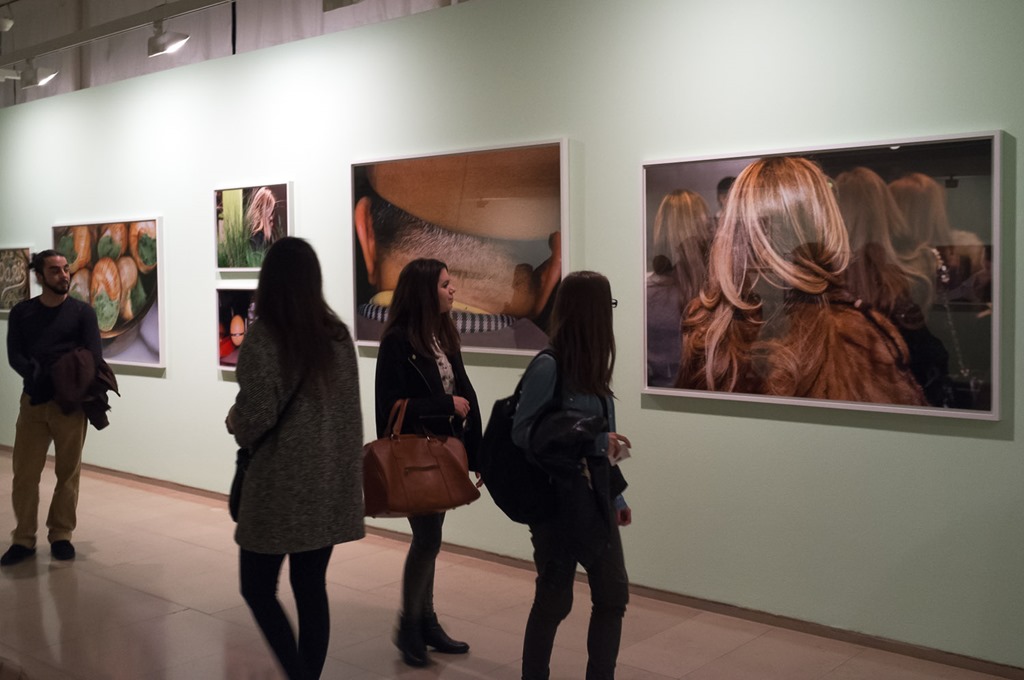
On this wall, a garish image of ‘escargots’, their shells covered with smooth hair-like patterns and their insides stuffed with bright green garlic butter, are juxtaposed with a woman’s head of flowing hair and a wispy green ‘hair-like’ plant.  At first, the image of two hard-boiled eggs below seem out of place, until we see the ears of the man in the next picture – who appears to have just had his hair shaved, judging by the little pieces lying on his collar and scarf.  Then we return to the long, flowing locks, and so on …  It isn’t especially sophisticated, but it works (for me).  It occurs to me that Parr’s aesthetic is that of the advertising poster or the magazine.  That makes it familiar and easily accessible – populist, I guess.  It is certainly different from Adams’.

That’s why I found these two exhibitions such a fascinating contrast on the same day.  It’s a bit like an exam question – compare and contrast – which do you like best and why.  I’m prepared to admit that the Martin Parr had more appeal for me.  Adams, great as he is, feels as though he is speaking from a different time – all balance and reason, form and composition, restrained black and white.  Parr is today – attention-grabbing, noisy, assertive, full of colour and energy, often superficial, always on the move.  I wonder what each would make of the other’s exhibition?  As successful professionals, they would have mutual respect, of course – but something makes me feel that Parr’s respect for Adams would be greater than that returned the other way!  Who knows.


diCorcia at the Hepworth–not sure!

Di Corcia - Hepworth-4

Even with the space of a few days to reflect, I find myself unsure about my response to the Philip-Lorca diCorcia retrospective at the Hepworth Gallery, Wakefield, which I visited with fellow OCA students & tutor, Andrew Conroy, last Saturday.  It’s a big exhibition; and I also remain slightly sceptical of my own ability to take in work that I view with a large group of people – useful as study visits and contact with fellow students are, always.  I need to go back and look again.  But the uncertainty of my reaction is also, I think, about the work itself – and our group discussion also reflected the same questions, I recall.

It is a retrospective, as I say, but somewhat unusually the work is apparently presented in a sort of reverse order – starting with East of Eden, his more recent and ongoing work that follows the economic collapse of 2008 and relates to both the Old Testament ‘Eden’ and the Steinbeck novel of the same name as the series.  It then progresses with Lucky 13, his photographs of female pole-dancers (partly, apparently, reflecting the images of falling bodies at 9/11); Streetwork and Heads, both created – in different ways – on the streets of major cities; the famous Hustlers series depicting male prostitutes from Hollywood’s Santa Monica Boulevard; and ends with A Storybook Life which was published as a book in 2003 but stretches right back to 1975, and so, fundamentally, reflects his earliest work.  Everything except the final group, is presented in the form of very large prints (the most recent being inkjets), but the 76 prints for Storybook Life are on a more intimate scale, running as a series around six walls in two connected but separate spaces.  The general reaction of our group, to which I would largely subscribe, was that we found the recent work somewhat contrived and difficult to ‘enjoy’; the oldest work the most accessible and, probably, most ‘enjoyable’; and what went between impressive and thought-provoking, whilst open to question as well.

It’s never a bad thing to consider what words immediately spring to mind when reacting to works of art – the ‘gut reaction’.  I wrote down “Impersonal, detached, formal and intellectually thought-provoking” – but I would add that those words apply less to the Storybook Life series.  Let’s take the well-known Heads series, as in this composite image taken in the gallery.

Heads - Di Corcia - Hepworth

Famously, diCorcia set up strobe lighting on scaffolding, which was then triggered by passers-by, whose faces were captured in split-second isolation as they walked the streets of New York.  The accompanying curatorial text uses words such as “anonymous” and “enigmatic”.  I had seen most of these before in books but here they are printed very large and command your attention – but I’m left wondering what they actually say to me.  It is only diCorcia’s isolation of their ‘portrait’, his formalisation of their image as a beautiful print, and his decision to make them so big on a gallery wall that gives them any significance at all.  We compared their creation to the Cartier-Bresson ‘decisive moment’.  Whilst that idea itself may have become open to question, it was at least formulated on the idea that the photographer’s mind/eye combination would select the significant instance in which to press the shutter.  In this case, the photographer created the situation, but left the ‘moment’ to chance and has, as a result, created significance out of insignificance.  That isn’t such an unusual approach in photography, of course; in fact, it’s what I’m doing myself, certainly with the studio work.  But I think that’s where I end up with this work (and perhaps where diCorcia ends up, too) – it’s quite formal work about the medium of photography and its relationship with the truth and the real, just like so much contemporary work.  It certainly isn’t about these people, or even about people at all,  It’s about the combination of camera and light to create a momentary ‘something’, which might provoke questions in the mind of the discerning viewer.  It’s also diCorcia overcoming his reticence about photographing people, using a detached and impersonal approach that essentially ‘removes’ him to one side of the process.  It’s about modern photography’s ability to produce monumental gallery images that have the sort of presence formerly associated with painting.  And it’s also about the art market – naturally!

Di Corcia - Hepworth-3

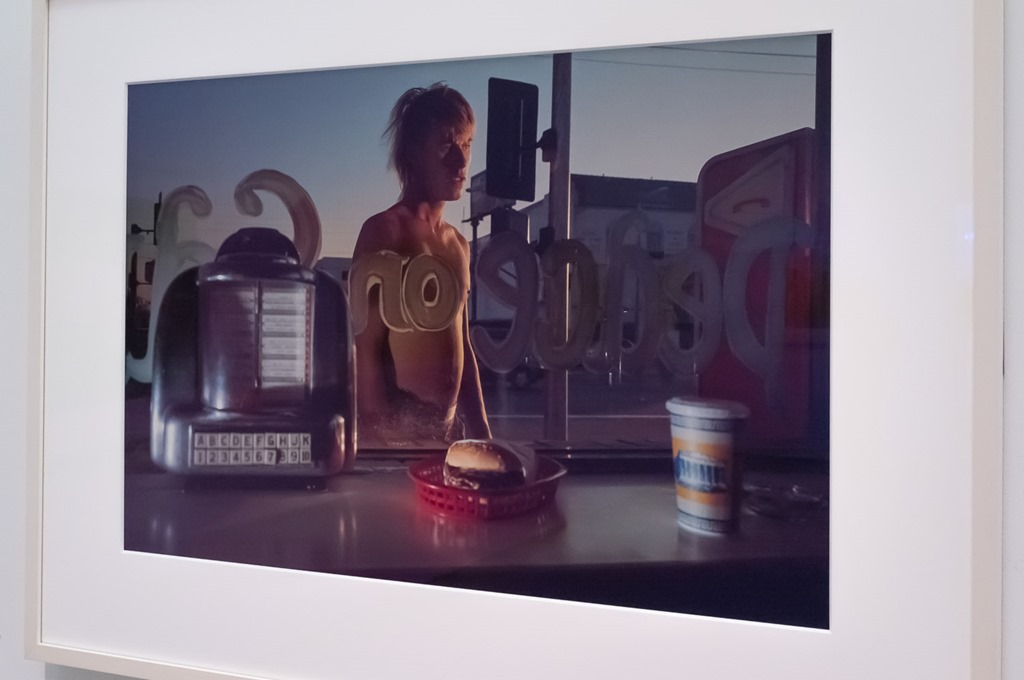
(Almost all of the images in the gallery were glazed.  In order to avoid ‘starring’, I have shot these at an angle.  I pondered whether to contact diCorcia’s office for permission to use the actual images but decided to use my own.  That was partly prompted by the fact that the one below, taken from the front seat of a car, seems to work quite well at this odd angle!)

Mention of ‘market’ brings me to Hustlers, the series with a transactional dimension to it. diCorcia paid the prostitutes to have their portraits made; the fee being whatever they would normally charge for sex.  We know that, from the history of the work and from the accompanying text; and we know the amount from the captions.  So we must assume that diCorcia wants us to view these images in the full knowledge of how they were made.  That, for me, makes them much more ‘personal’ than the Heads series.  The subject knows that he is being photographed and has collaborated with diCorcia in the process and pose.  The gallery text compares the two forms of transaction, concluding that they are “… both forms of selling their bodies for another use”” …” and also suggesting that “… the men depicted become a collective symbol of broken dreams …”.  I can see both those points, of course, by I also got this sense of detachment again.  They almost all stare off into the distance, which kind of makes the ‘dreams’ context a bit obvious.  And I wondered whether the beautiful cinematic lighting and (again) high quality gallery-size print didn’t almost glorify their circumstances and pander to the dreams, to an extent.  There were two exceptions to the ‘distant stare’; and I felt that there was more in these two images – both individually and as a contrast – than in the others.  What a difference when the subject is looking right back at us.

Di Corcia - Hepworth-1 Di Corcia - Hepworth-2

Now the detachment is gone and we are engaged with and by the young men.  And what a contrast in the gaze.  For me, these two were the most effective in the Hustlers series – yet they were the least typical.

To my surprise, it was the A Storybook Life series that engaged me most.  There is a ‘flip through’ the book here.  I didn’t really get fully to grips with it in the limited time available, and I do intend to go back.  The sequencing was fascinating and needs more time – I sensed that sometimes it was based on form, sometimes colour, sometimes subject matter, and sometimes unconnected detail.  With 76 images on the walls, there was plenty of opportunity to speculate about that aspect.  Many/most of the images are ‘staged’, so we are still working with that aspect of diCorcia’s work – photography’s ability to explore/challenge truth and reality – but the smaller scale and the variety (and quantity) of images seemed to invite a more ‘human’ engagement.

And there I come back to being ‘unsure’ about my overall response.  diCorcia’s reputation would seem to rest, mostly anyway, on those big ‘block-buster’ series like Heads and Hustlers; and those series are impressive and thought-provoking.  But I find myself more interested in some lesser-known and less immediately impressive work where, rightly or wrongly, I felt there might be more of diCorcia the person/artist.  It is a very big exhibition and I really do need a second visit.  To be continued …!

Edited with this addition 20th April 2014

I have been back – last Thursday.  Reading through this post, written just after my first visit, I tend to think I got it ‘about right’.  This time I went through in chronological order – and I think that’s the right way to do it.  The ‘A Storybook Life’ series is a fascinating one – both for its content (some ‘real’ and some ‘constructed’) and for its form & sequencing.  I found myself wondering whether I was ‘forcing’ my interpretation or genuinely ‘reading’ the work.  But I think that’s the very point – di Corcia is presenting us with a stimulus and leaving us with plenty of scope to put our own interpretation on it.  ‘Heads’ seems, even more on second viewing, to raise questions about the photographic image on a gallery wall.  There is, I sense, nothing at all in the subject matter of the images; they are entirely ‘insignificant moments’.  Only the photographer’s combination of a flash of light, carefully positioned and primed equipment, selective editing, and printing to monumental size, is significant.  And the more recent work feels unfinished, which I suspect it is.  I’m glad I went twice; I broadly feel happier with the work and my reaction to it after a second viewing; and I now rate it rather higher, overall, than I did first time round.