Author Archives: standickinson

#selfie–thoughts on study visit at Bank Street

image (3)

It isn’t often that you enter the front door of a gallery to be immediately confronted by the artwork, scattered all over the floor in front of you such that you have no option but to walk on it!  But that is exactly what happens when you arrive at Bank Street Arts to view Tom Stayte’s #selfie – immediate engagement and participation.  I was there on Saturday, with a small group of OCA photography students, for a study visit led by tutor Andrew Conroy and including the opportunity to talk with Tom Stayte, the creator.  The work (see here) was Tom’s graduate show at Sheffield Hallam University; is currently on show at Bank Street; and will be at the forthcoming Format Festival – and rightly so!

Where to start? Probably with a description, I think; though the work doesn’t fit neatly into any formal categories.  At the core, but hidden within a white plinth, is a computer.  It is running some bespoke software that constantly looks at uploads to Instagram that are tagged #selfie. The image is ‘examined’ to see whether it contains a single face, and if it does, the image file is downloaded.  A monitor on top of the plinth relentlessly lists the files as they come down.  On the front of the plinth is a thermal printer – the sort of thing that prints receipts at the supermarket, no ink involved and paper supplied from a large roll.  As the image files are downloaded, it prints each one, low quality monochrome, to a standard size, and then cuts each one, leaving it to fall on the floor in front of the plinth.  (There is potential comparison with 24 Hours, the work in which Erik Kessels printed every image that was uploaded to Flickr on a single day; which I saw in Arles 2013.) Tom estimates that it prints an image every five seconds and it chattered and chopped endlessly throughout the two hours plus that I was there.  The prints from the graduate show have been brought forward to this show and the plan is to take these ones on to Format.  The estimate is around 100,000 so far!  It is only running when Bank Street is open, of course.
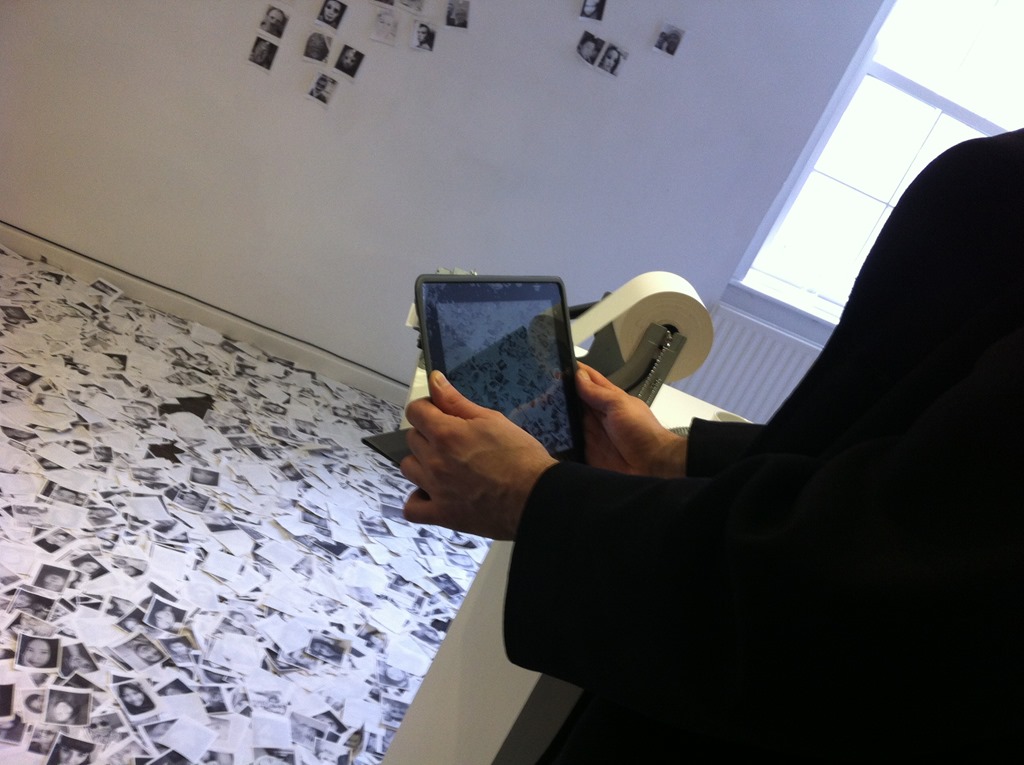
image (4)

So, one might ask ‘what is it?’ – a piece of research, social comment, political provocation – well, my reading is that Tom’s intention is that it is a work of art, and that is how I would view it.  And art is entitled to ask and provoke questions without providing answers – which is exactly what #selfie does, in my view.  It is a provocative piece, from the moment you enter, as I’ve suggested.  Is it appropriation?  The work uses thousands of photographic images, created by thousands of photographers all over the world, without any formal ‘rights’, so ‘appropriation’ would certainly seem like a word that could be applied.  Is it curation? There is an element of selection (even if it is automated) of printing and display.  And as the image above shows, a degree of participative curation is happening, with viewers encouraged to rummage amongst the output and look for patterns, anomalies, whatever, and pin them on the wall.  So the art is evolving as it is viewed.  Is it, maybe, even, a kind of performance?  Once the computer and printer are in action, there is a kind of hypnotic effect as you watch and listen – yes, sound is a part of it, actually; you can hear it in the video on Tom’s website.  Is it, perhaps, something uniquely digital; a new form of art that could only be associated with ‘now’?  It is certainly an example of an artist embracing what digital technology has to offer as a form of expression and representation; a way of creating potential for meaning for the viewer.

The work does, of course, invite thought and reflection on the phenomenon that has become the ‘selfie’.  It has its own inherent definition of what the term means – an image of a single face uploaded to Instagram and tagged #selfie, for the purposes of the project.  That imposes some inevitable boundaries and almost certainly means that we’re looking at the tip of a very big iceberg of what actually exist as potential ‘selfies’ in internet-space.  On SelfieCity, a project led by digital media writer Dr Lev Manovich, Alise Tifentale’s essay The Selfie: Making Sense of “Masturbation of Self-Image” and the “Virtual Mini-Me”, quotes the Oxford Dictionary definition of ‘a photograph that one has taken of oneself, typically one taken with smartphone or webcam and uploaded to social media website’ – but Selfie City’s project, like Tom’s work, uses Instagram as the source of its images.  But perhaps the most obvious question that this work raises, whatever the definition and source of the information, is ‘Why?’. Why do all these (predominantly young – that’s clear from a quick scan of the faces upturned on the floor at Bank Street) people want to make and share public ‘selfies’?

Tifentale’s article reviews academia’s response to the selfie, from which she concludes with these phrases – means of self-expression; construction of a positive image; tool of self-promotion; cry for attention and love; way to express belonging to a certain community.  All of those, individually and collectively, could be concluded as one stands amongst the output from #selfie and watches the mounting mass of images.  At the same time, partly prompted by Tom’s understandable choice of a cheap, low-aesthetic method of printing, the utter pointlessness of it all comes across strongly.  These are instant, throwaway images; and surrounded by tens of thousands of them in a small space, it’s actually hard to see the connection with a ‘positive image’ (especially seeing the expressions on some of the faces).  The sharing and belonging makes some sense – after all, it is the existence of a sharing platform, Instagram in this case, that makes the whole concept of the proliferation of the phenomenon possible in the first place.  And, whilst these are all public images available for the world to see, one might propose that they are primarily directed at friends and contacts, rather than the global audience. (Though, as we speculated on Saturday, few of the uploaders can have anticipated that, within seconds, they would be part of an art installation in Sheffield!!)

For my own part, both at the exhibition and in subsequent reflection, I feel most drawn to a comparison with language – both spoken and written.  These small, individual, seemingly insignificant images are like words – spoken or written to friends.  Maybe most like spoken words, in the way that they are created and dispatched into the ether – then often forgotten and ignored.  Sitting with a friend, having a drink, at a bar in sunny New York, Joe says to Anna, “This is nice; I feel really relaxed.” Then he lifts up his phone and creates a selfie, uploads it to Instagram, and a few moments later, their friends Jack and Lucy in London see the image and Jack says “Joe looks happy.”

Of course, as he’s saying that, #selfie in Sheffield prints Joe’s picture and Stan picks it up from the floor and pins it to the wall, with several others of people wearing reflective sunglasses, that have been uploaded in the last couple of hours!

image (14)

There exists a potential for some negative reading in this, naturally.  What does it say about people’s willingness to share many aspects of their lives through a media that is open to all sorts of exploitation and control by all manner of other individuals and organisations – corporate, official, criminal, insane?  My own take, whilst certainly acknowledging such negative readings, is that I am mostly drawn back again to these comparisons with casual conversation and social interaction.  The ubiquitous shared digital image seems to me to have much in common with the shared words of language – pictures painting a thousand words etc.

Many thanks to Andrew for leading such a fascinating and thought-provoking study visit – and, of course, to Tom Stayte, for creating such a stimulating & novel project and for spending time with us on Saturday.

Duchamp’s Ghost

Self Portrait as Reclining Nude - Nat Essdee - 1982

Marcel Duchamp has put in a number of ghostly appearances in my reading of late; no great surprise, I suppose, since he haunts so many corners of contemporary art.  His ghost is in this image, my latest in the Portraits series; but I’ll come back to that.

One of his manifestations was in a two article series in Hotshoe magazine (Autumn and Winter 2014) by A. D. Coleman, on Photography and Performance Art.  Coleman discusses the photographic documentation of performance art and staged or directorial photography, and he questions whether there is much, if any, distinction any more.  He moves on to include the idea of ‘performance’ in life and/or the ‘amateur’ creation of photographic/film records of ‘performances’ – raising the question of how we distinguish between artists and non-artists.  He makes the comment that performance of the self has become a staple of contemporary art (which, unsurprisingly, struck a chord in the context of my own work), as has the theatricalising of just about everything.  It’s at this point that Marcel makes his appearance.  Coleman says that both these, we could say, “spring from Duchamp” – his refusal to paint representing symbolic action and a heightened awareness of self as actor in the field of ideas in art.  I wondered, briefly, about the theatricality of my self-portraits here, when writing about Thomas Demand, and Coleman makes me wonder again. Are these actually photographic records of my performances in the roles of particular characters?  At one level, the answer to that question must be ‘yes’, because that is, technically and in ‘reality’ what they are.  It’s back to intentionality.  The images, at a base level, record only that I took a photograph of myself playing a particular role.  In a series, though, supported with text, presented in an ‘art’ context, they may have new significance.

Which brings me to a second Duchampian haunting.  Rosalind Krauss’ Notes on the Index were written in 1977 and were reflections on American art of the seventies; but her consideration of indexicality discusses photography, and Duchamp lurks everywhere.  The ‘empty sign, or ‘shifter’ requires a physical relationship to establish meaning.  She uses the example of pronouns such as ‘I’ and ‘you’, which have no meaning unless used in relation to, say, a particular speaker or object of speech.  This is the category of sign termed the index, and it includes cast shadows, for example.  So she discusses the cast shadows of ‘ready-mades’ in Duchamp’s “Tu M’ “.  The ‘ready-mades’ themselves were signs arbitrarily extracted from their Symbolic significance and given new meaning by Duchamp; and in that painting, their shadows are the indexical signs – except that they aren’t, because it’s a painting, so they’re actually representations. Krauss credits Duchamp as being the first to establish a connection between the index and the photograph (including work with Man Ray, for example), and we get the assertion that every photograph has an indexical relation with its object.  But this is more than a technical issue based on the marks left by light on a sensitive surface.  The photograph isn’t the object it shows; it’s an empty sign detached from that object, symbolic only of the photographer’s act until the viewer is ‘pricked’ by something that goes beyond the merely Symbolic and enters the Imaginary, touches the Real.

OK – a lot of theoretical, psychoanalytical stuff there!  Blame goes to Contextual Studies!  Actually, it’s another declaration of how CS informs and supports what I’m doing in this Body of Work.  There are many strands in those last paragraphs which can be applied to both of my projects.  And, as I’ve already said, there is the spirit of Duchamp in so much of it.  Which brings me to the latest ‘self-portrait’.  It’s entitled “Self Portrait as Reclining Nude 1982 Nat Essdee.  The ‘back story’ is this:

The only evidence of this work by the late American artist Nat Essdee is a scanned version of a photograph taken by his partner, British photographer Stan Dickinson.  Essdee died of an AIDs related illness in 1989 and it was never clear whether the work was lost, destroyed or sold to a private collector. Dickinson, who died two years later, had claimed that the piece was his idea and was actually a portrait of him.  The only surviving print of the photo is owned by the Dickinson family, who have allowed Tate Modern to scan and use it in publicity for their forthcoming Essdee retrospective.

So, there is a nod to Duchamp’s ‘ready-mades’ in the use of sieve, nuts and bolt; reference to the photograph as evidence; a question about authorship; and maybe even a small observation about the workings of the art market.  And that is to say nothing of the mingling of traditional photographic methods with digital images, implied by the scan of the print – presented digitally, here, of course.  A bit ambitious, perhaps, thinking I can get all of that into a single image!!  It’s what comes of so much background reading and study!  The brain becomes soaked in all that theory and creativity; hardly surprising that it seeps into the output.  (It is a scan of a print, by the way! Must have an authentic process.)

Putting it out there–tentatively!

A fellow OCA student, Tanya Ahmed, based in New York, sent me some information, a few weeks ago, about a call for exhibition entries by the Colorado Photographic Arts Centre.  In their 2015 Month of Photography, they have a theme of ‘Role Play’, emphasising self-portraits by artists who “embrace themes related to transformation of self; the exploration of social traits; race and gender identity issues; or simply for play.”  Firstly, many thanks to Tanya for passing it on and for spotting the connection with my own series of portraits.  Secondly, close as the fit might be, this was always going to be a very, very long shot!!  However, I did decide that it was an opportunity to put my work out there; to go through the process of entering something; to make myself think about presenting the work in some coherent way.  Unsurprisingly, I wasn’t successful.  They had 100+ submissions and have chosen eight artists, about half of whom were pre-selected anyway; and no great surprise that the majority are USA based.  There is information about the exhibition here – CPAC Role Play – I wish them well.  Wouldn’t that have been something – ‘Blackpool Stan’ and ‘Dick Stanley’ in Denver Colorado?

One outcome has been that the process made me think about an online way of presenting the work – so I have produced a website, using Weebly.  It was put together very rapidly over the Christmas period but could potentially form part of the final submission of the project, perhaps with a little refinement.  It is here:

where nothing is real

Thanks, again, to Tanya for thinking of me.

“Variation of development time with temperature”–a new construct

Variation of development time with temperature 6

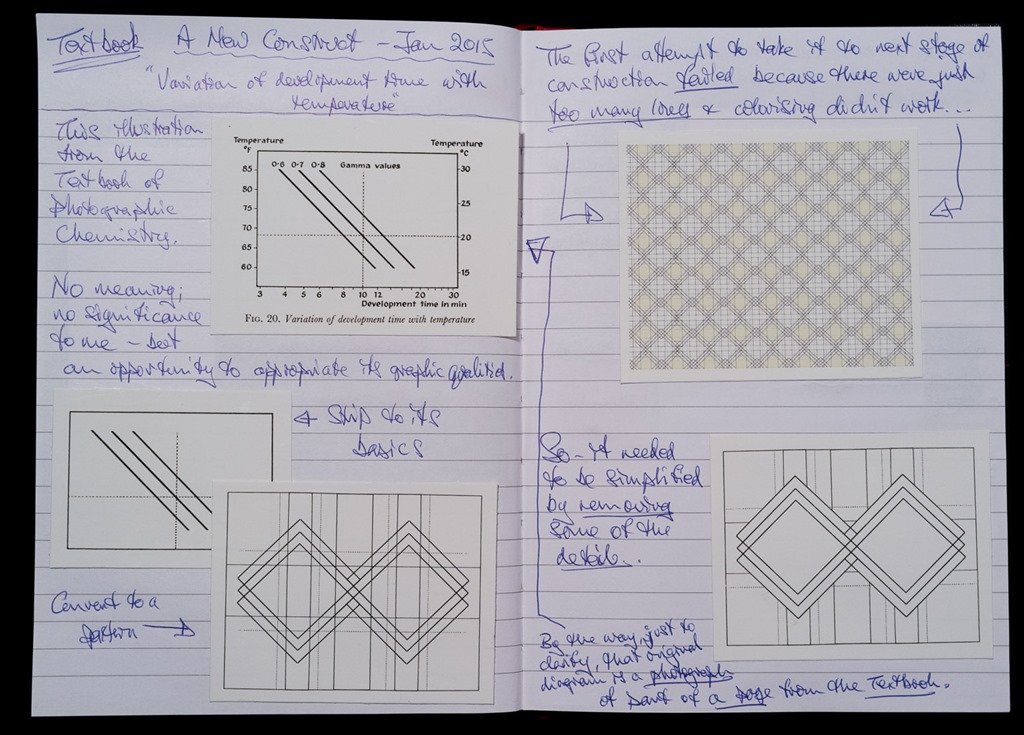
This is the latest ‘construct’ in my ‘Textbook’ series, which I have been developing over the last week or so.  This image is its latest, and probably final form.  The post, with the aid of some illustrations from my notebook, chronicles the process of its development – from a line drawn diagrammatical illustration in “A Textbook of Photographic Chemistry” to this colourful image, of which more later.  My (badly!) handwritten notes, together with the notebook illustrations, set out the way it has emerged and so I am only going to support them with brief words in this log.

Variation of development time with temperature -1

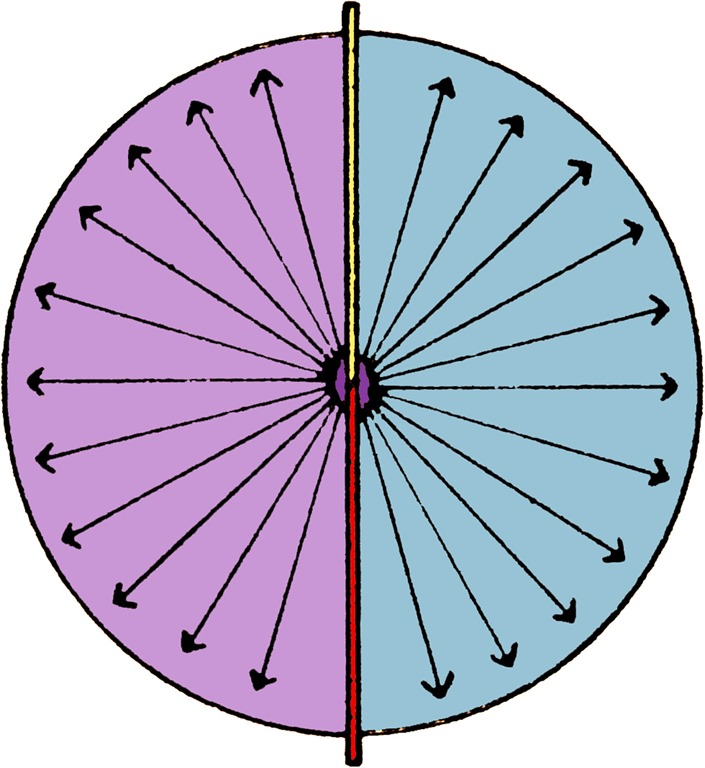
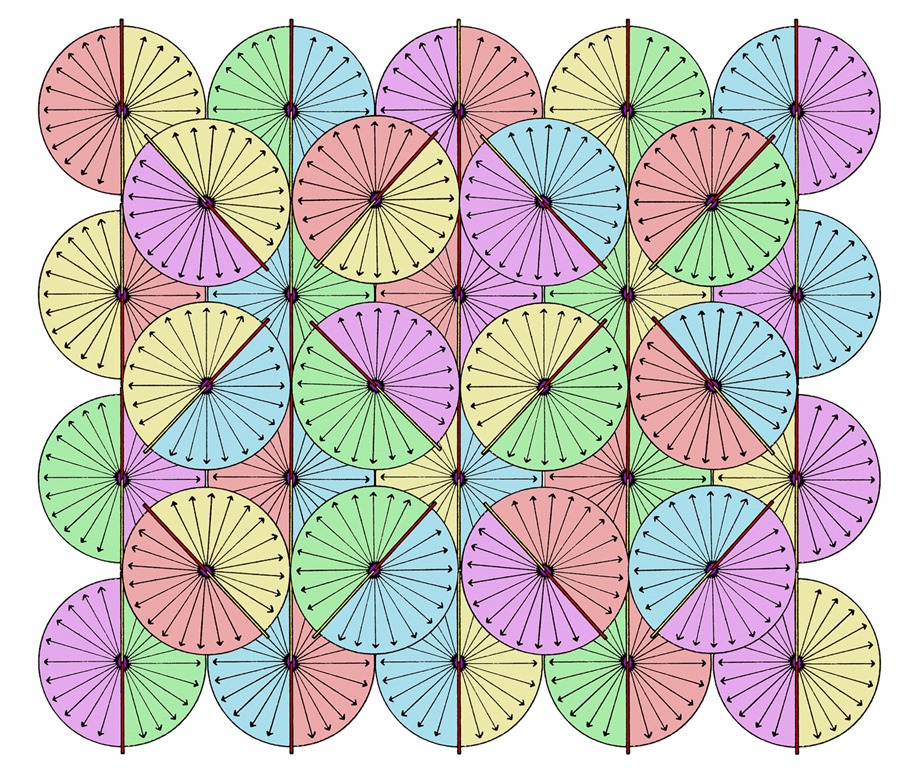
The original diagram illustrating development time variation with temperature is top left above.  Like everything else in the Textbook, I have started out by photographing it; then stripped it down (in Photoshop) to some basic lines and worked it into a simple ‘module’ for my pattern.  The first version, bottom left above, was too complex and so I cleaned it further, to the one bottom right, above.  That simple module is then overlapped on itself and repeated (as in the complicated grid, top right above) and coloured (in Photoshop) to produce the pattern shown top left in the image below.

Variation of development time with temperature -2

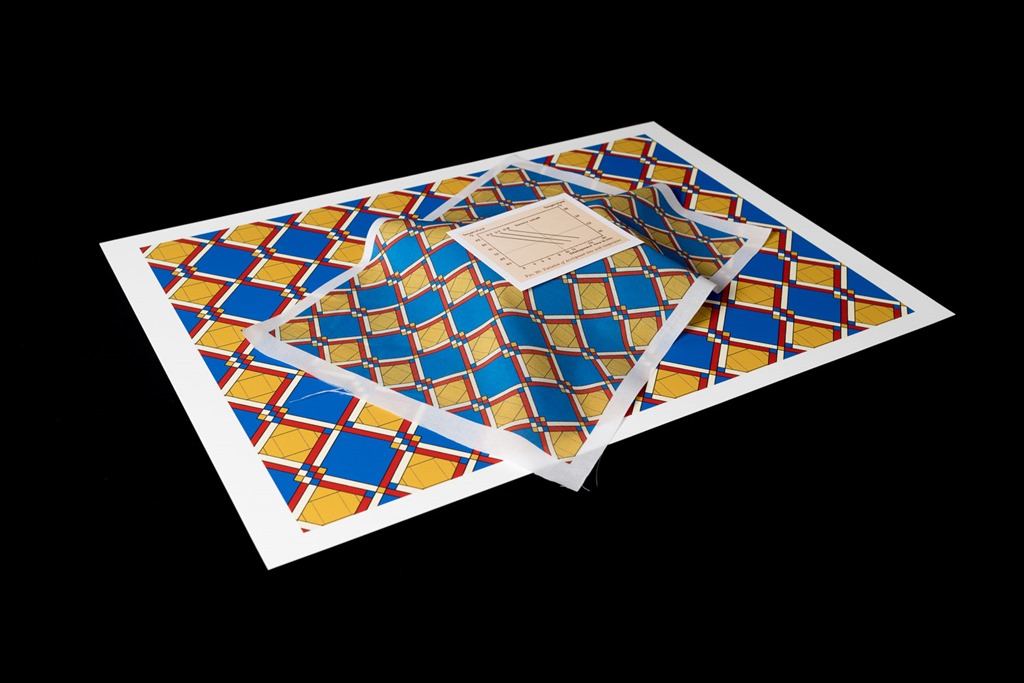
As I was producing the pattern, and particularly when I started with the blue coloured shapes, I was reminded of some patterns and colours that I’d seen six years ago, in the Moorish architecture/interiors of Andalucia.  Some of my photographs of tile patterns and stained glass are shown above, bottom left.  I didn’t try and copy the colours but did take a cue from the combination of hues.  As with all these constructs, I printed the basic pattern onto fabric and the image below repeats the one top right above, combining paper print, fabric print and original diagram into a ‘still-life’ that matches the style used for previous constructs.  (I also experimented with a different method for getting an image of the fabric print back into the PC.  Bottom right, above, is a scan of the piece of fabric – though I didn’t end up using that version.)

Variation of development time with temperature

When producing previous fabric prints and constructs, I have wanted to try ‘hanging’ the fabrics and photographing them hanging.  I haven’t worked out an effective way to hang them together (imagine a series of rugs hanging in a market …), though I may get there at some stage.  However, I did come up with a ‘sort of’ version of hanging, which is on the left in the illustration below.

Variation of development time with temperature -3

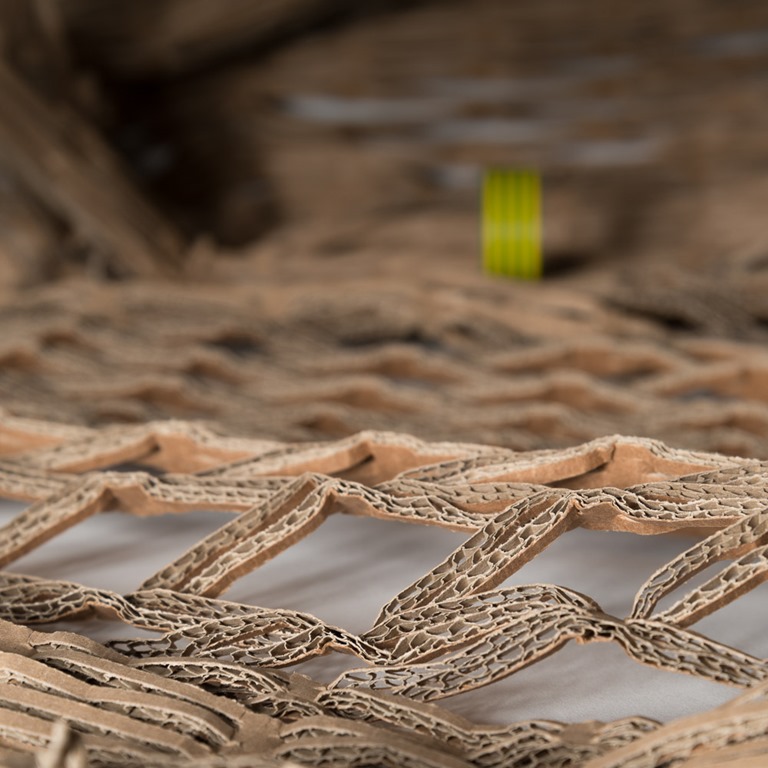
The fabric isn’t very visible here, but it is hanging in the back of this light tent – and it is being back-lit with a studio light low down behind the table.  The paper print from the ‘still life’ is standing, vertical, on a makeshift cardboard frame inside the light tent, and has had some of its blue and yellow ‘diamonds’ cut out of it with a craft knife, so that the camera (placed in front of the tent, but not shown here) can ‘look’ through onto the fabric hanging behind.  Overall light is supplied from another studio light directed from above onto the top of the tent.  Actually, I experimented with different combinations and positions for the lighting, some of the results being shown on the right, above.

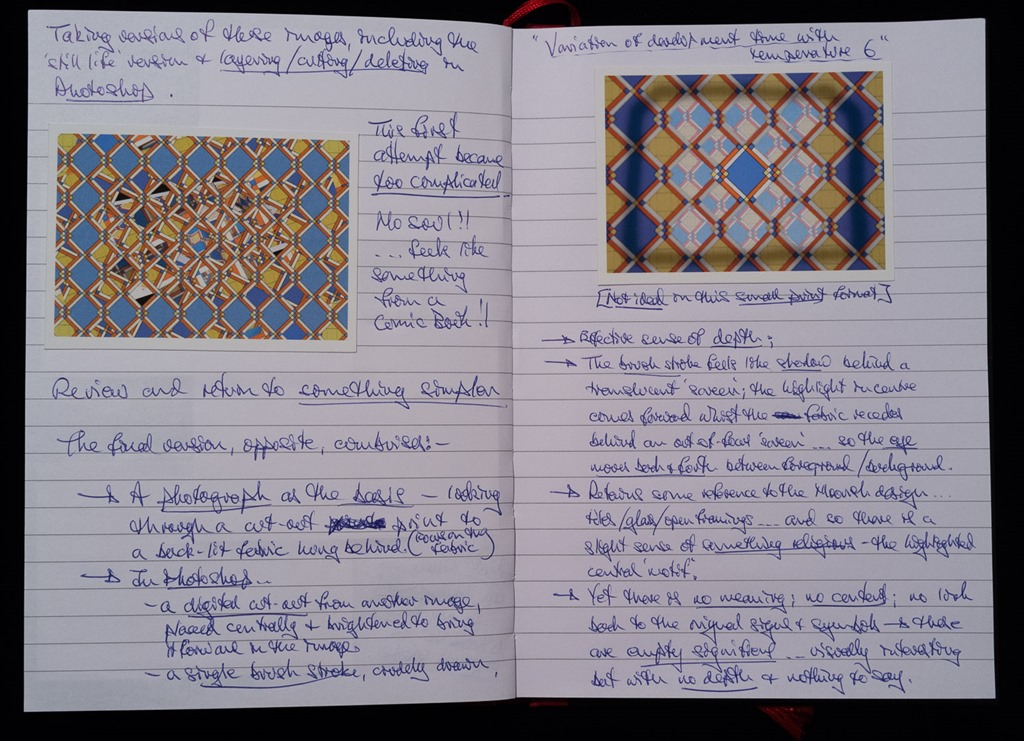
With some basic images to work from, I moved on in the same way as with other constructs, experimenting with layers and combinations in Photoshop, deleting and blending different images and parts of images.  My first version is illustrated on the left, below.  I got carried away and created something so complex that it just looked a mess.  The large printed version looks like something from a Comic Book!

Variation of development time with temperature -4

That led me to go back to my light tent set-up and produce a new, tighter framed version, working with the back-lighting and a shallower depth of field (focus on the fabric at the back) to produce something that would form the basis for my final image.  That photograph has had just two further process performed on it in Photoshop.  Firstly, I have ‘digitally cut’ a sharp-focus version of the ‘central motif’ from another image and placed it ‘in front of’ the out-of-focus centre of the photograph – bringing it right forward in the image and giving the feel of stained glass (or that’s the intention, at least!).  Then I have used a broad but not very dense brush to make a crude brush stroke mark around the outside of the image – producing something vaguely resembling a shadow.  It has (I think!) given a slight impression that the foreground might be a translucent screen.

There is, of course, no meaning, no content; the image is another empty signifier constructed from ‘dead’ symbols whose significance – to me – is lost and of no consequence.  It is (I think) visually interesting and has the potential to intrigue a viewer, maybe even to tempt some reading of its significance.  Visually, it gives (especially in a large printed version, but also in the screen version at the top of this post) a sense of depth, that we are looking through layers at something lit up at the back of the frame.  It is, though, a flat surface and its meaning is just as flat – there is no depth!  It says, only, that I have constructed it and presented it here.  The process of making these images still intrigues me and I like the outcomes – but after that they are outside my control …!

Thomas Demand–Constructedness, Madeness, Intentionality

Thomas Demand Gate Artslant

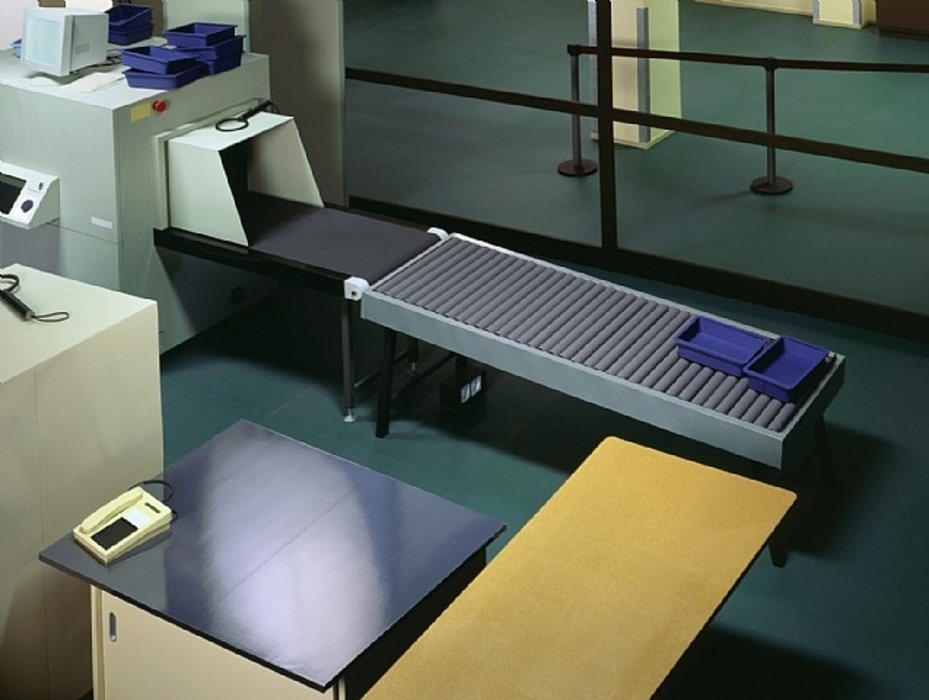
Gate, 2004, Thomas Demand (reproduced with the kind permission of the artist and The Design and Artists Copyright Society)

I can recall when I first encountered the work of Thomas Demand; it was this image, featured at the beginning of the book Image Makers, Image Takers by Anne-Celine Jaeger.  Like, I’m sure, many others who see it for the first time, I thought it was a photograph of an airport security gate.  Then one looks closely and it doesn’t feel right.  We begin to realise that it is something very different – a photograph of a model of an airport security gate, a model constructed life-size, by Thomas Demand, from a still from a CCTV camera.  The image was made not too long after 9/11 and the model was constructed from cardboard and paper – ‘realistic’ and yet not so, missing the little details that would finally convince the eye that it was ‘real’.  That’s what unsettles the viewer; what makes us start to ‘question’.  Demand photographs the model, carefully lighting it to mimic the original photograph; and then he destroys the model.  It is the photographic image that is the work of art, not the model.  (Worth mentioning, though, that Demand started out as a sculptor; and that when he chose to learn Photography, he did so with Bernd and Hilla Becher.  He resists the description ‘photographer’ and, so far as it matters, I suppose one should call him an artist who uses photography, rather than a photographer.)

I have been drawn back to Demand, partly, at the recommendation of Peter H, my Contextual Studies tutor – not that I’d forgotten him but I hadn’t made as strong a connection with my own BoW as I might have done.  The words ‘construction’ or ‘constructedness’ have cropped up more than once in my Level Three studies – the title of the Foam Magazine edition #38 from Spring this year – Under Construction – in which many of the contemporary photographic artists from whom I’ve drawn inspiration and context were featured.  My own reference to some of the Textbook series images as ‘constructs’.  It would, I think, be fair to describe Demand’s images as ‘constructed’.  But what are they?  How do we understand what he’s doing and why?

The process generally seems to start (as well as end) with a photographic image.  Other examples include Saddam Hussein’s kitchen, an office in Hitler’s HQ after the failed attempt on his life in 1944, Engelbert Humperdinck’s display of his best-selling records, the tunnel where Princess Diana was killed, the barn where Jackson Pollock was photographed making one of his paintings, and so on – a decidedly eclectic collection of starting points.  In this interview, Demand explains that if he knew what it was about certain images that strike him, he would stop!  He doesn’t know what it is.  Clearly, there could be a political angle in our interpretation of some of the subject matter above.  In the same interview, he more or less denies it – or at least he says that any such connection is indirect and he would be careful about making too much of it.  I think he is acknowledging that others might understandably read the work that way, but he doesn’t see it as art’s role to give an answer.

And so, back to the question of what he is actually doing and what its significance might be.  Here I head back to another book that I originally read some time ago – Why Photography Matters as Art as Never Before by Michael Fried.  Here, Fried devotes most of one chapter to Demand, and a comparison with two others from the ‘Becher school’ – Thomas Struth and Candida Höfer.  He relates Demand’s images to the concepts of ‘theatricality’ and ‘antitheatricality’ – originally associated with Diderot but used by Fried, earlier, in his essay Art and Objecthood, published back in 1967, in which he defined Minimalist art as ‘theatrical’.  I certainly don’t have the time and space here to get into the detail but, as I understand it, Diderot argued that Painters should seek to create work in which the ‘beholder’ does not get any sense that what he/she sees has been staged for them.  Otherwise the work is merely ‘theatrical’.  Fried’s 1967 essay laid this description on Minimalist Art.  However, what interests me here is that he also uses the concept – and its opposite ‘antitheatricality’ to analyse Demand.

Fried argues that Demand’s images demonstrate “sheer artistic intention”, leaving the viewer no space other than to register their “madeness” (not a typo, by the way; though there could be some who would say madness!).  The ‘photograph’, having frequently been defined as ‘weak on intention’ is exploited by Demand to ‘represent’ or ‘allegorise’ intendedness.  This is complex; the reference to photography’s weakness on intention can be linked with Barthes’ ‘punctum’.  Barthes seems to identify the punctum as something that is outside the photographer’s intention – Fried (in another essay, 2005 – Barthes’s Punctum) uses the example of the dusty road in a Kertész photo of a violinist that is featured in Camera Lucida.  The photographer cannot avoid including it (possibly debateable today, but that’s of no consequence here) yet it is the feature that evokes Barthes’ travels in Hungary and Rumania – the punctum.  Fried also mentions Lee Friedlander’s declaration that photography is a “generous medium”, for all the things that it includes in an image that he did not choose to put there.  So, returning to Demand, Fried is arguing that he exploits this weakness in the sense that he is making photographic images that are “sheer artistic intention” – and it is this intendedness/intentionality that makes them matter as art.  He uses two more Demand images to further develop the argument.

Thomas Demand Poll MCA Chicago

Poll, 2001, Thomas Demand (reproduced with the kind permission of the artist and The Design and Artists Copyright Society)

In Poll, Demand is working from a photograph of the process of determining voter intentions in the US Presidential Election – the famous ‘hanging chads’.  But, in Demand’s version, the ballot papers are pristine, devoid of detail like everything else; so being “the bearers of no intention other than the artist’s own”.

Thomas Demand Sink liveauctioneers

Sink, 1997, Thomas Demand (reproduced with the kind permission of the artist and The Design and Artists Copyright Society)

Fried looks at the circumstances surrounding the making of Sink.  Demand thought of making a model of his own sink but realised that he could not avoid arranging items in it knowingly.  So he telephoned a friend and asked if they would take a photograph of their sink. Circumventing his own sink, Fried says, put the emphasis squarely on conscious process.

So now I am prompted to consider if/how this is relevant to my own Body of Work.  The ‘constructs’ from the Textbook project seem like the obvious place to start.  I have referred to them as being devoid of meaning but seductive (a word Demand uses about models in another interview), tempting a viewer to look for meaning.  I suppose the same could be said of Thomas Demand – the only reading, in the end, might be that someone has made a model and photographed it.  We search for signs of ‘reality’ but all traces have been removed, leaving an image about itself.  Interestingly, Demand also, apparently, leaves small traces of his construction work, which can be found in the detail of the image.  So, the only ‘reward’ for looking in detail is confirmation of his intent.  Perhaps the tentative links back to the old textbook are my equivalent of Demand’s ‘link’ to an original image.  But the link is broken – my appropriation of the ‘outmoded’ signifiers – so what is left signifies nothing other than that I made it.

I suppose that, if the Portraits look like a performance for the viewer, then they will be ‘theatrical’.  And, when viewed by people who know me, they could be entertaining.  And, when I combine them with text that tells the back story in a light-hearted manner, the result could be entertainment, too.  But I have been striving to make them capable of ‘working’ as ‘straight’ photographs – that would be read as signifying a ‘real’ identity if seen in isolation.  However, viewed ‘straight’, as a series, by someone who doesn’t know me or anything about me, their individual (indexical?) links with reality are devalued.  At that stage, I guess, they demonstrate nothing other than that they have been made.

And then I reflect that it is not up to me to find answers to such questions!  Context – be it theoretical or in the works of other artists – may inform and even inspire the work I produce.  It is useful, essential perhaps, to be able to talk about one’s work in a context and to see what kind of questions it might raise.  But it is not up to the Body of Work to supply answers.  My Portraits (Self-portraits?  Or whatever they are?) express something about my response to some aspects of life, my life, the world I encounter.  If they are any good, others will look at them and see something that is of interest to them, relevant to them in some way.  If they were really good, someone might choose to analyse them and write about them.  In a fantasy world where they came into the consciousness of Michael Fried (!), he might choose to consider whether they are ‘theatrical’ or ‘antitheatrical’!  And no doubt that question might hover around in the back of my own mind … maybe even influence, to a slight extent, the way my mind is working when I set up the next one and stand in front of the camera.  But, in the end, the work will be the work … no answers, but hopefully a few interesting questions.

Stranger Than Fiction–Joan Fontcuberta

JoanFontcubertaStrangerThanFictionLogo240

I finally managed to get to this exhibition – and I wasn’t disappointed!  Fontcuberta’s work has already featured in here and in my Contextual Studies, as has his writing.  His highly creative and imaginative use of photography to create fiction; his intelligent and thoughtful essays; and his subversive sense of humour, too; they have all proved informative and inspirational for this Body of Work.  But this was, apart from the occasional image seen in multiple-person exhibitions, my first opportunity to look at his work ‘first hand’.  The show, which moved up from Media Space at the Science Museum in London to the National Media Museum in Bradford, during the autumn, includes work from six different projects.  It seems sensible to look at them under those six headings.

Fauna

Based on the ‘discovery’ by Fontcuberta and a colleague, of the archive of mysterious and controversial ‘zoologist’ ‘Professor Peter Ameisenhaufen’, Fauna presents ‘documentary evidence’ in the form of diaries, photographs and ‘taxidermy’ of the strange creatures that he came across through his research and network of ‘informants’.  It is, of course, all fiction, but superbly presented – and all the more subversive and provocative for that.  There are samples of handwritten notebooks, smudged, stained and blotted;  there are bone samples, sound recordings, even ‘stuffed’ animals; there are typed up versions of the handwritten notes, printed on yellowish, punched paper and pasted to the ‘museum-green’ walls; and of course there is the indisputable photographic evidence – black and white, grainy, sometimes blurred by the ‘animal’s’ movement!  All of which creates a slightly dated, museumish feel  that at one and the same time precisely reproduces the evidence-based approach of many 19th and early 20th century scientific explorers, and totally subverts it.

A number of points worth noting to inform my own work are:

  • the combination of text with photographic images to create fictions;
  • the appropriation of photographic (and language) styles;
  • the deadpan delivery, but with humour;
  • and the way in which, besides the direct questions about photography and truth/evidence, the work touches on some wider ethical issues e.g. the recurring and apparently innocent explanations of the deaths of the captured species, the references to their behaviour in the contexts of birth, death, reproductions, responses to humans;
  • the completeness and thoroughness of what was presented.

Herbarium

Again, strong references to traditional photography of botanical specimen, e.g. Bosshardt, applied to constructed ‘plant’ samples that are completely artificial and made from all sorts of household objects, as well as real plant parts.  The selection of beautifully lit and printed black and white images was displayed on a single wall, perfectly evenly spaced, in three rows, with an equivalent numbered printed key at each end that listed their scientific names. An entirely ‘convincing’ and deadpan presentation which again both reproduced and subverted the original genre of image.  A strong reminder here of how aesthetics can add credence to a photographic presentation – even a fictitious one.

Orogenesis

In this work, Foncuberta moves into the genre of Landscape – in traditional painting, in fine art photography, and even in geography.  These images, printed large scale and often in full colour, mimic the sublime modernist landscape photographs; yet, once again, they are fictions, and not even photographs in this case.  In many cases, they combine, strangely, map-reading software and paintings.  The software, used by geographers, reads scanned map images and converts them into 3-D terrains.  But Fontcuberta has (as he put it in one of the exhibitions films) also ‘fooled’ the computer.  Instead of maps, he has fed in scans of paintings (and of body parts in some cases), from which the software creates 3-D fictions, to which he then adds details, such as animals and water and sky.  The outcome is interesting and effective – though it does have a computer-generated feel about it, to be truthful.  And this reaction was probably not helped by having watched one of Disney’s most recent animations, Frozen, a few days before.  Created in 2002, Orogenesis cannot match up-to-date Hollywood CG landscapes – though I’m not quite sure just what I’m saying there, since both are entirely in the hyper-real bracket! So what is the benchmark?

Constellations

This is an earlier body of work that, again, does not involve the use of a camera.  Claiming to be a keen amateur astronomer, Fontcuberta has ‘depicted the night sky’.  The key word here is ‘depicted’.  It isn’t the night sky at all but, according to a passing comment in another exhibition film, mosquitos and other insects splattered on the screen of a car.  He doesn’t explain exactly how the images are produced, but presumably it is some form of photogram.  The most interesting aspect for me, again, was the presentation.  Quite large scale images, principally black, with spots and splashes of white, were hung either side of a dimly lit space, and I was immediately reminded of Sugimoto’s monumental ‘sideways’ landscapes in Arles 2013, where the scale, muted black and white tones, and dimmed lighting produced something akin to a religious experience.  Fontcuberta hadn’t quite achieved that, but he was, I think, appropriating and subverting the style.

Sirens

This section is based on the history of another mysterious ‘historical’ character – Father Jean Fontana – who discovered, whilst living and teaching in the Southern French Alps in 1947, the fossilised remains of an extinct (mythical?) creature called Hydropithecus alpinus, half monkey, half fish.  Fontcuberta, has been hired by National Geologic (sic) magazine to do a photographic study of what is now a ‘World Heritage Site’.  There is a life-size plaster cast of one of the perfectly preserved skeletons, in a glass case, surrounded by large-scale, full colour prints of the site and the fossils.  Camera angles, compositions, use of focus etc, all copy the ‘fine art’ style of such ‘real’ magazine photography – albeit somewhat self-consciously.  There are other artefacts associated with Father Fontana, in glass cases, a ‘mock-up’ of the feature as it appeared in ‘National Geologic’, and a documentary film that would site perfectly comfortably on one of the dozens of documentary TV channels – apart from the occasional surreally gauche moment that just keeps everything on the ‘wrong’ side of ‘truth’.  This was, perhaps, the most complete of the fictions, with less text than, say, Fauna, and was probably the best section of all, for me.  It brings home, again, the importance of ‘completeness’ in presenting fictions, including a ‘back story’.  I have been debating how to use the ‘back stories’ with my own Portraits series and this exhibition has convinced me that I should give serious consideration to their inclusion in quite an overt way.

Karelia, Miracles & Co

Gallery fatigue was, I admit, beginning to set in by this stage.  This is a series that I had probably given most pre-attention to – given the use of the ‘self-portrait’ – but I found it the least satisfying in the exhibition.  Great fun, of course, and delightfully ‘delivered’, but erring a little towards the ‘daft’.  Of course, this could well have been deliberate, since there is a kind of double-bluff going on here.  The monastery in Karelia that supposedly trains monks to perform miracles is being visited by an investigative journalist and photographer, Joan Fontcuberta, posing as a novice monk.  So, the outcome, given that this journalist has set out to expose the monastery as a fraud, has a deliberate agenda to make things look ‘daft’.  So Fontcuberta is certainly not sending up the monastery and its miracles but he is questioning the approach of the investigative press, with their preconceived ideas and their tendency to look more for spectacle and entertainment than for ‘truth’.

So, a well-presented and thought-provoking exhibition that has helped me understand the quality, thoroughness and sheer creativity of Fontcuberta’s work.  It was inspiring and informative for my Body of Work, giving me confidence, particularly, with the Portraits series.

Assignment Three–Submission, Feedback & a Farewell

Tapes Ass 3-6

I submitted Assignment Three just over a week ago and have had my feedback.  The quite lengthy submission notes are here, if anyone is interested in ploughing through.  As is evident from the notes and posts on this blog, the Portraits and the Textbook project have been progressing well; and Clive’s feedback agrees with that.  Both projects are heading in the right direction; I have ideas for their eventual submission; and when I submit the fourth assignment in the Spring, I anticipate that both will either be completed (in terms of image-making) or very close to it.

The Tapes project, on the other hand, has had rather less attention and so, unsurprisingly, has developed less direction.  I proposed the possibility of dropping it and Clive agrees.  So decision made – farewell Tapes, and the stripy character is disappearing over the horizon in the image above – either in a ‘huff’ or to enjoy his freedom!  Actually, I quite like some of the work in that project and could return to it at some stage.  For the Body of Work module, however, there is sufficient meat in the other two.

So, onwards and upwards; we seem to be making progress on all fronts!

Textbook Project–entering a new phase

Pages - the Cut

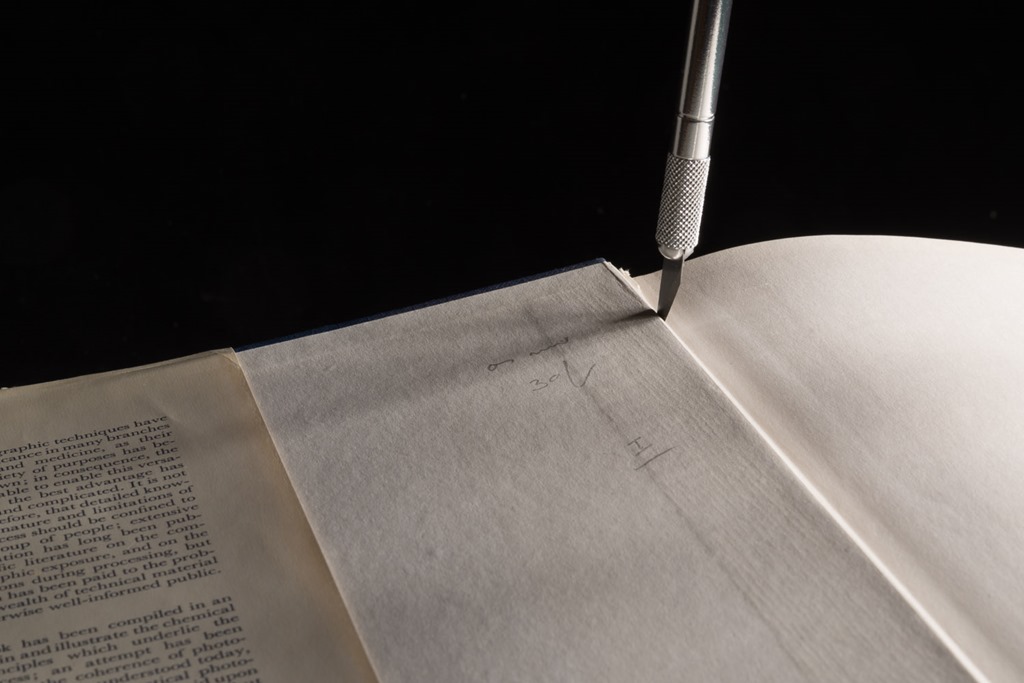
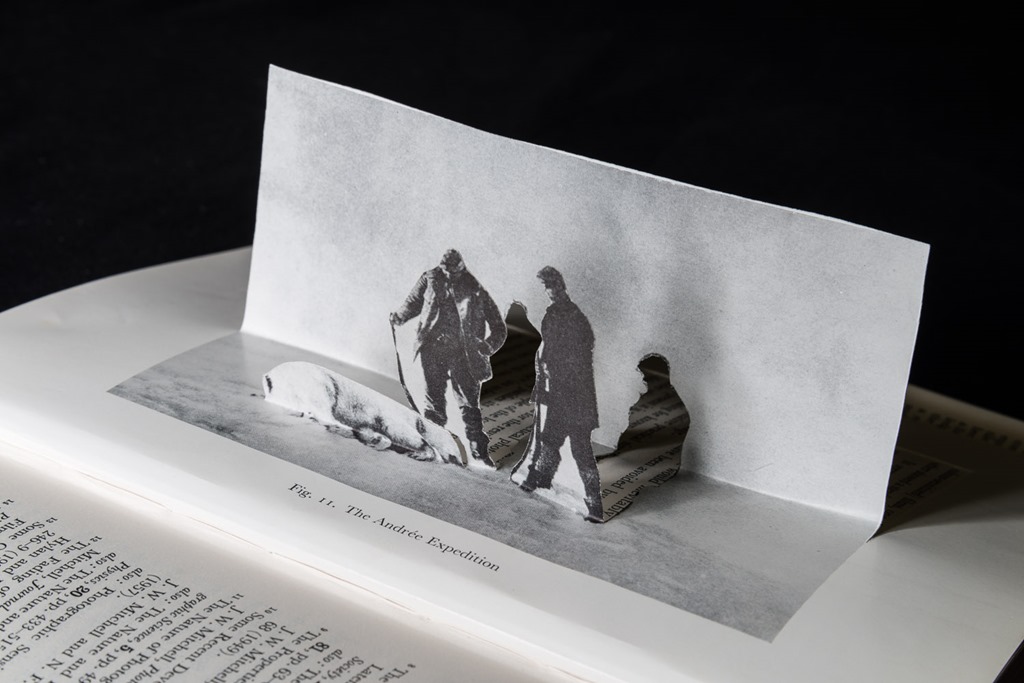
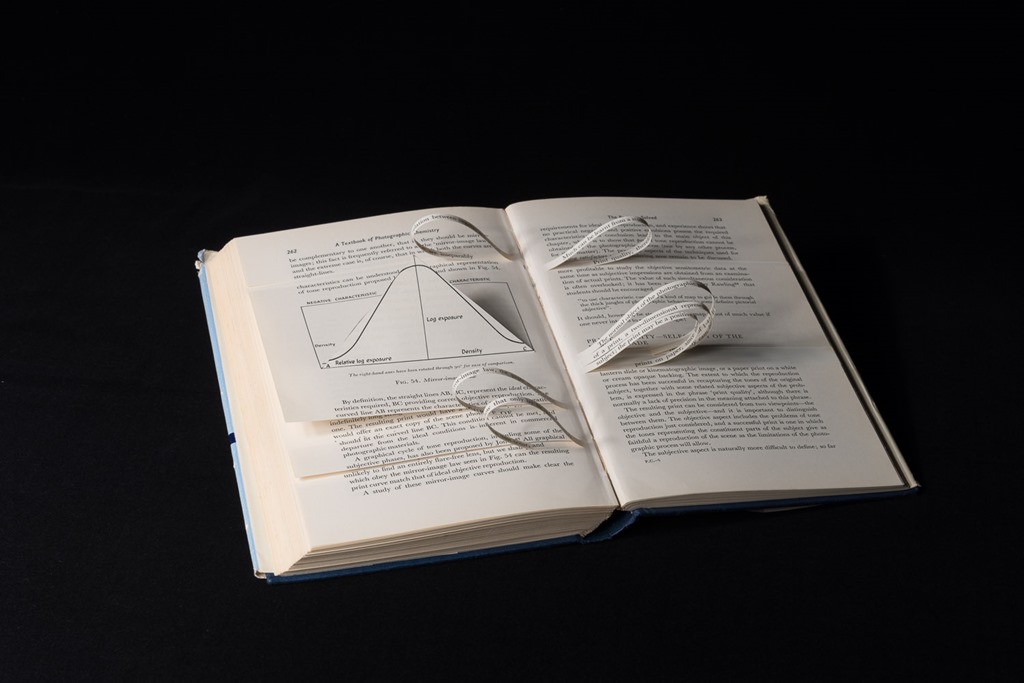
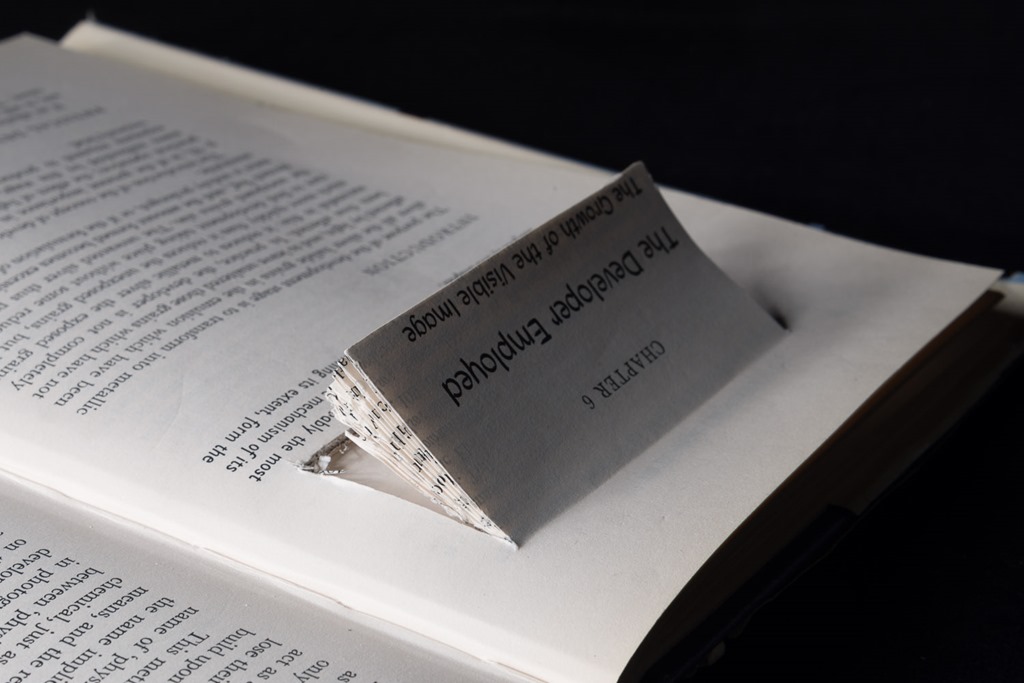
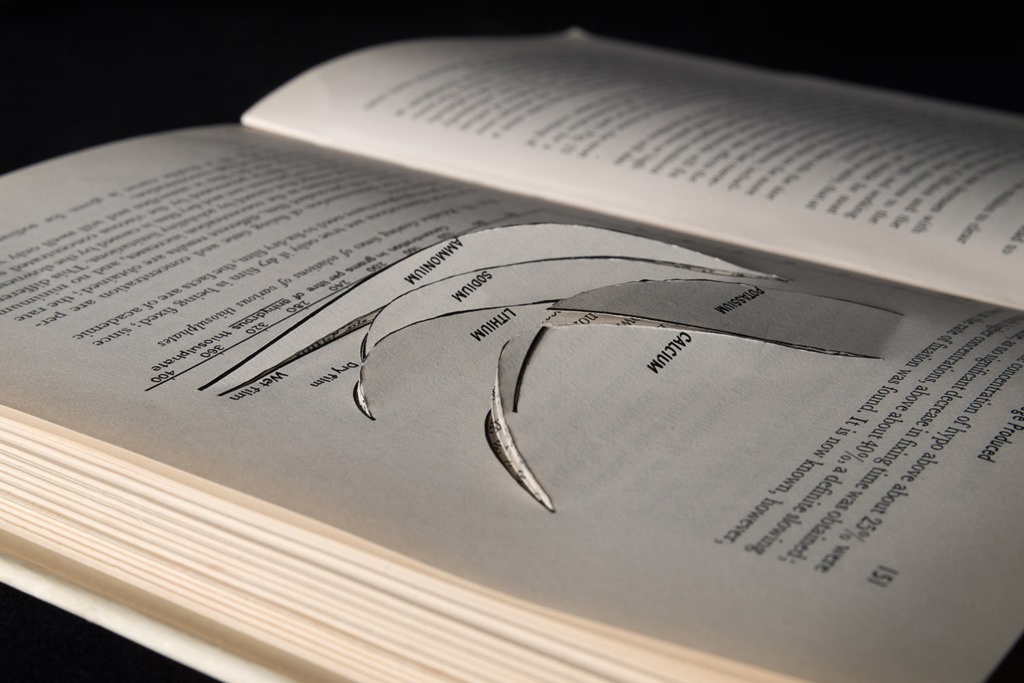
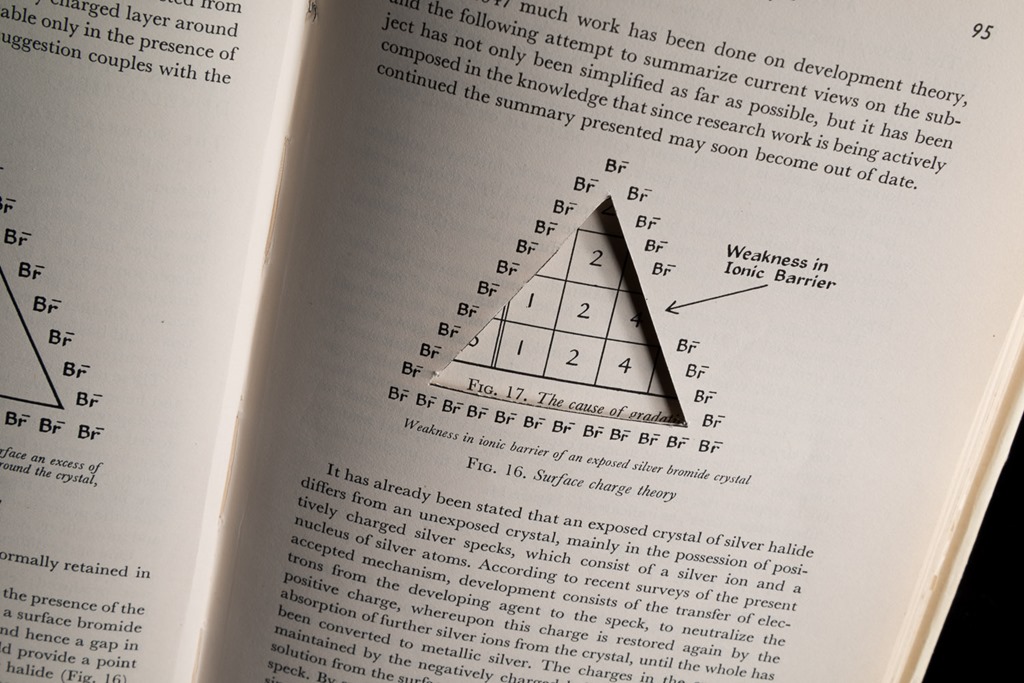
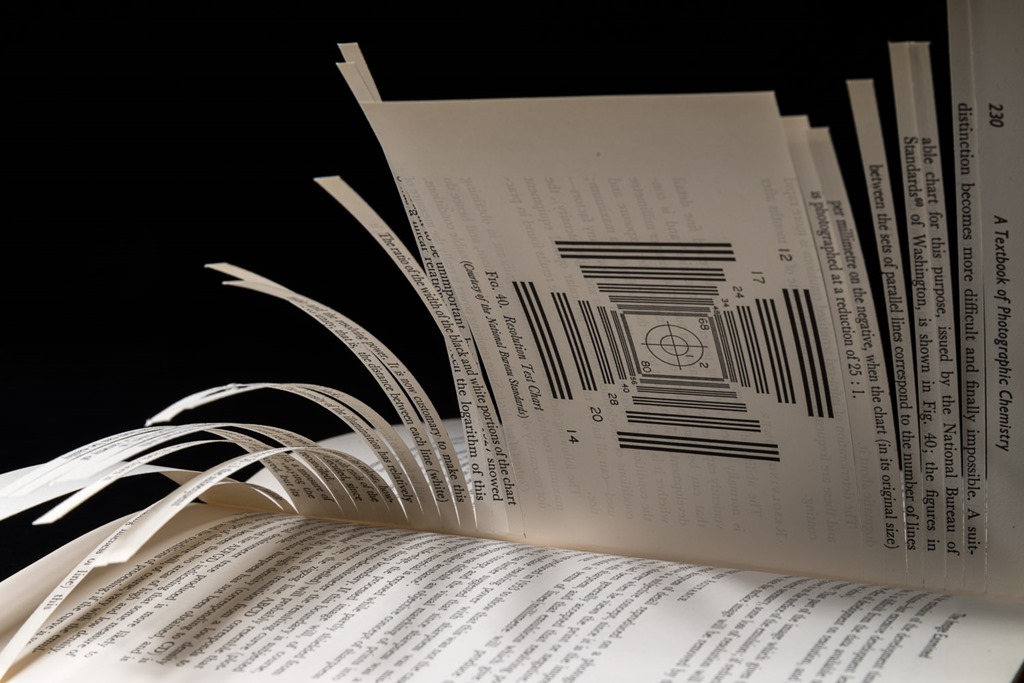
I have always expected, intended perhaps, that the direction of this project was likely to include a physical destruction of the book.  The most recent images have been complex, layered constructions, which appropriate diagrams – signifiers – from the book and re-present them in new ways that bear no apparent relation to their original meaning.  I blogged about one recent one here and another one here.  The most recent of all came in for some interesting discussion on Flickr here.  I haven’t necessarily exhausted the possibilities with that part of the project – far from it, actually – but it has felt like a good time to move things on to another phase.  (In order to keep options open for further constructions, I have, by the way, created a digital photographic copy of the entire book – 178 images of all double-page spreads, front/back covers, and so on.  It took me about half a day but I can extract and manipulate further elements, should I wish – and it also keeps open options to create a PDF version, slideshow etc, too.)

But, as I say, the physical destruction was always a possibility – likelihood, actually – and it has begun.  I ought to explore the motivation or intent behind this new part of the process.  It has various sources, actually.  One is, I must say, instinctive, emotional, intuitive – a kind of basic, natural desire to do it.  Contextual Studies might inform me that this comes from my unconscious – perhaps it does – my failed Chemistry O-level, still haunting me; some base, unacknowledged desire to see the victory of digital over analogue; or, worst of all, a destructive nature that was suppressed as I entered the Symbolic Order as an infant.  Whatever – I have felt an urge to ‘cut’ the book!  (So, no matter what I might now write about the intellectual context and justification; the influences of other artists; the metaphor for the demise of chemical photography; all will be meaningless because it’s really just a desire to destroy things!)

However, I am going to refer to some artistic influences – and they are genuine, as it happens.  Firstly, getting on for two years ago, I attended an exhibition at Manchester Art Gallery called The First Cut.  Quoting from the page on that link “31 international artists who cut, sculpt and manipulate paper, transform this humble material into fantastical works of art for our stunning new exhibition”.  It’s one of the most inspiring exhibitions that I have ever seen – artists with amazing skill and craft but also with outstanding vision and creativity.  All were excellent and several of them ‘cut books’.  This was one of my favourites – Georgia Russell ‘The Story of Art’ – and hopefully some very loose connection with where my Textbook Project is going is clear.  A second influence is here, in the work of photographer, Abelardo Morell.  I came across his work during my Level Two Studies and, whilst it does not have the destructive characteristics that I’m demonstrating, I do like the aesthetics and the form of his book photography, and have sought to bring something of that to my own project.

And so, the following series of images may be a metaphor for the fate of chemical photography.  It may be my very crude response to the inspirations of Georgia Russell and Abe Morrell.  It may be some sort of apocalyptic exploration of the postmodern hyper-real.  And it may just be me satisfying a destructive nature that has (thank goodness!) remained buried in my unconscious since just before I first saw myself as the ‘other’ in a mirror image, way back in rural Lancashire in the early fifties …

Pages 45 FacingPages 247-248-FacingPages 262-263-1Pages 225-226-1Pages 59-90-Chapter 5Pages 151-160-1Pages 94-95Pages 123-124-FacingPages 190-191Pages 230-231-1

This is the more creative stage of this new phase.  I suspect that things are going to get messier!

Portrait–in the style of …

A18640.jpg

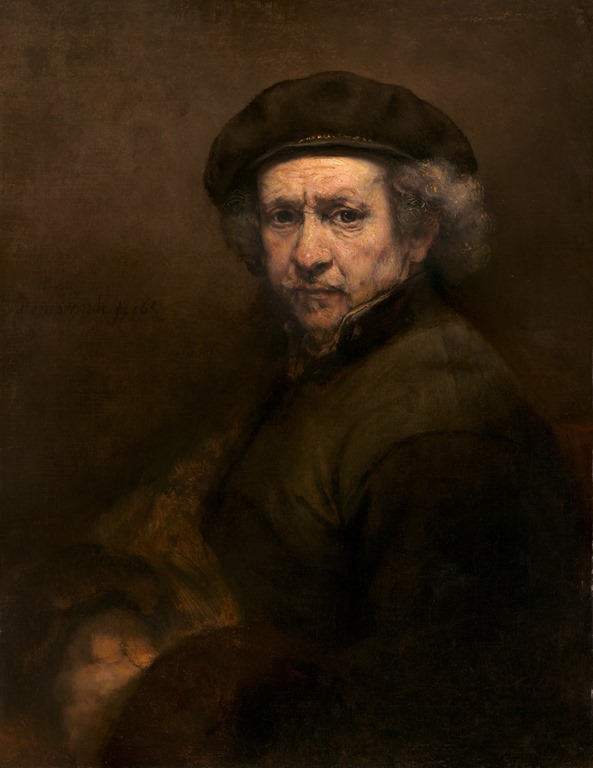
Rembrandt van Rijn Self-Portrait 1659 National Gallery of Art, Washington

Last week, I saw the latest National Gallery ‘blockbuster’ exhibition, Rembrandt – the late works.  There were many fine works on display, of course, from collections all over the world; and the exhibition presented another of those ‘unique opportunities’, especially for someone of my age, to experience them together in a way that will certainly not happen again in my lifetime.  That ‘threat’ in the publicity for such events could sometimes prompt us to go to something we’re not actually that bothered about, but I was quite keen, in this case, for the chance to look first hand on some of his famous self-portraits.  Actually, Simon Schama had done quite a persuasive job; and I had also seen Rankin ‘recreating’ some of the portraits on TV, too; so there were a few influences.

In fact, the Rankin programme had given me an idea as to how I might resolve one of my own planned ‘self-portraits’ – the left-wing politician.  It had gone through various iterations in my mind – ex-Cabinet Minister photographed outside the London School of Economics; veteran back-bencher photographed in his study – but the programme prompted me towards a retiring local politician being photographed for a Town Hall portrait, in the style of a Rembrandt.  I noted that Rankin didn’t go the whole hog and try to create something that looked just like the paintings; more a case of ‘in the spirit of’ Rembrandt.  I researched some of the self-portraits online; and it soon becomes clear – not surprisingly –  that viewing online, or even in print, only gives a clue as to what the painting might look like, in terms of tones and colours; and then there is the question of surface, of course.  I had a go, anyway, with warm, subdued lighting, warm colours of clothing; a chair and pipe as props; a neutral but not plain background; dignified but human stance and gaze.  When I shared the portrait on Flickr – here – the response was good, with many people suggesting it was the ‘best’ of the portraits so far.  One comment, from Clive, suggested that it might look under-exposed, which it certainly does, out of context; but further clarification led to a feeling that it was its flatness that might be the issue.  To be fair, I hadn’t paid too much attention to the detail at that stage – because I was going to the exhibition and wanted to get a feel for what the paintings themselves looked like.  Recreating the exact feel of a painting is impossible, but I wanted to see the actual tones and colours and lighting.

The 1659 Self-portrait above – the very first painting in the exhibition – was the one that really attracted me and kept me looking.  It normally hangs in the National Gallery of Art in Washington and there are notes about it here.  Rembrandt was 53 at the time and, seemingly, emerging from some tough times – financially, personally and professionally.  It is a deeply engaging image and I spent some time in that first room (which it shared with a group of other self-portraits).  This reproduction, from the NGA website, is a good one; and the portrait was nicely lit in the National Gallery, reproducing the quite warm front light from above, as in the painting itself.  The notes tell us that it went through restoration in 1992, and the light really glinted off the surface on the forehead and nose – little highlights and brushstrokes on the surface that ‘brought it to life’.  A photograph – whether presented on-screen or in the form of a high quality print – is never going to match that, as I have already said!  However, informed by the painting and by Clive’s comment, here is Councillor Stan’s portrait, adjusted slightly from the original ‘out-of-camera’ shot, ready to hang in the Town Hall.

Councillor Stan

My colours area little warmer than the version of the Rembrandt at the top – but I recall it looking a bit warmer than that when I saw it.  And I have the light at a slightly different angle – but it’s ‘in the style’’ of’, and it may get a bit more tinkering as time goes by.  How, though, could I dream of getting even remotely close to anything like the real thing?

Textbook Project–developing another image!

From this …

_DSC6285


… to this …

Diffuse and Specular Density Pattern 5

Diffuse and Specular Density Pattern 5 – Construct

To be clear on one thing … I don’t know what ‘Diffuse and Specular Density’ means!  I have looked in the ‘Textbook’ and read a few sentences, but they don’t make much sense to me and I don’t intend to look any further because I have no need of that knowledge and only a very passing interest in it.  As I have said before – this project involves deliberately appropriating ‘signifiers’ from one context and giving them a new ‘life’ elsewhere.  Jean Baudrillard would suggest that ‘capital’ does this all the time, presenting us with images that are significant in their own hyper-real context, but which mask the lack of a ‘real’.  Diffuse and Specular Density Pattern 5 – Construct is certainly not a representation of anything ‘real’ – but it is, perhaps, seductive and interesting; certainly, to most people, more seductive and interesting than the diagram above it.  Yet it has no connection to anything other than its own ability to interest and seduce.  The diagram above it, though, if you understand what it signifies, has some potential to visually communicate a concept that has practical application in the process of traditional, film-based photographic image-making; so, on that basis, a lot more potential to be useful and of value than my construction!

It was a lengthy process, going from one to the other.  These are some of the steps:

Diffuse and Specular Density Diffuse and Specular Density Cropped

Diffuse and Specular Density Pattern 3 Cropped

Diffuse and Specular Density Pattern 3 Fabric Print

… and then printing onto fabric, creating a ‘still-life’ and re-photographing …

_DSC6706-Edit

… before constructing Diffuse and Specular Density Pattern 5 – Construct , which has five layers – top and bottom being versions of the last pattern, with three ‘angled’ versions of this photograph between them – and various stages of delete/reveal.

All that work to create something that is more seductive and attractive but of less ‘use’ than the original! Makes you think! Why?  But then, that’s the point of the project …